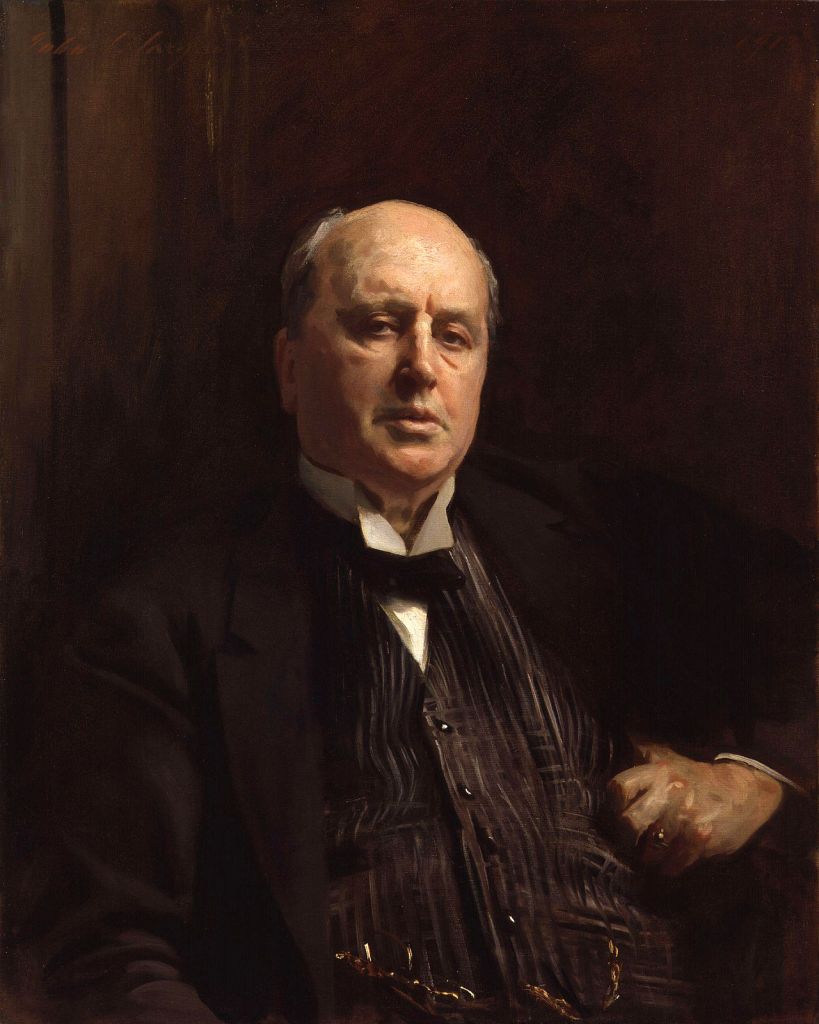
Henry James, of whom I presently, and with possibly the greatest literary joy of my life, have read anything and everything there is to read, is by far, one of the best, most refined, most scandalously clever authors, I have had the pleasure of reading. It is no secret by now, I am well aware, considering the bulk of essays in which I mention Henry James, that he is, with Herman Melville and George Eliot, my favourite of novelists.
I find reading Henry James at his best akin to the exuberant feeling I get when reading Shakespeare, Cervantes or Montaigne. It is that great tingling; a sensation of such vividness and immersion that, at times, to be specific, say in chapter 42 of The Portrait of a Lady, or in certain passages of The Golden Bowl or The Ambassadors, or at the climax of The Turn of the Screw, or even in James’s travel diaries, or within his obscurely written biographies, one cannot but put the book down, sit still; held, tight, tense, in the heat of the literary aftermath.
Like Shakespeare, James in his last novels especially, pushes prose to its very limit. He shows us with his unique style, which is often feared and quite villainised among his fellow (especially more modern) writers, that the English language is an elastic and compliant entity, one that is to be worked and stretched — and I think it not unreasonable to say exercised, in order to make progress of the representation of the ‘Self’. James’s exuberant style is not, as many critics will claim, a tool of pompousness or snobbishness, but rather a way with which we can go beyond, like Joyce and Proust, like Melville and George Eliot, in order to provoke the character’s (or reader’s) self-actualisation.
The following issue is not a literary analysis of James’s body of work, a future issue will make do on this. Rather, it is supposed to serve as a helpful “guide”, if you will, to where one is to start with Henry James. It is no secret that James’s style becomes more erratic, unique and difficult the older he gets. He even states himself that his last three great novels The Wings of the Dove, The Ambassadors and The Golden Bowl are to be read slowly, one sentence at a time, perhaps, as James explicitly said of The Ambassadors, only in sections of five or ten pages a day. The reason for the difficulty is as Gore Vidal and others have speculated that James, for health reasons, had to dictate the novels, rather than writing them himself. Which, in turn, produced a quite distinctive, difficult, almost new literary medium. Therefore, a guide is a helpful tool for the reader new to Henry James, as starting with either of the three aforementioned novels will almost certainly lead to a distorted, grim, overly difficult relationship with James. (And believe me, there are enough heartbroken Jamesian relationships).
I have separated James’s literary work into four sections of which each corresponds well with James’s age: (I) young James, (II) mid-life James (in which I have taken the liberty to super-separate the period), (III) late James, (IIII) the late late-James.
I. Younger James (1871-1880)
The younger James is very much accessible to most readers, and it is not on the whole a question of semantic comprehension, but rather a question of taste: if one, as it is, enjoy James’s style. His prominent longer novels in this period are Roderick Hudson, The American and Confidence in which one will find works populated by characters of warmth, stories of simple and uncomplicated romance, and prose accessible to any reader familiar with Victorian- or Edwardian-day language.
Of my favourite of his earliest novels I cannot rank any but The American highest, less so for our protagonist Newman, with whom one develops quite the intimate relationship (James referred to him in his ‘Prefaces To The New York Edition’ (1907) as: “a tall, protective good-natured elder brother in a rough place“), but moreso for Valentin de Bellegarde, and the friendship the two men develops. Adding to this, I have (personally) an affinity with novels set in Paris, and few novelists portraits Paris better than Henry James.
If one wants to start with one of James’s short novels, I deem Washington Square or The Europeans by far the best options. They are simple, straight-forward stories, the latter of which I have come to appreciate more so than Washington Square, as The Europeans is altogether a fine introduction to James’s easier, though still elegant prose, as well as a look at his life-long relationship, commitment, and persistent fascination with The United States contrasted with Europe.
II. Mid-life James (1881-1900)
James launches his earlier middle years (1881-1886) with a fantastic production of The Portrait of a Lady, The Bostonians, and The Princess Cassamassima. The latter two were considered critical failures in his time, though now, they are certainly recognised for their genius. Of the three novels I find The Portrait of a Lady to be as good as its reputation, if not, and I deem this very fair to say, much the better.
My own introduction to James came through The Portrait of a Lady. I have reread the novel thrice now, and with each re-reading, new layers open up. It is truly a novel populated with a Shakespearean cast of living, breathing, “self-moving” characters. From our freedom-seeking heroine Isabel Archer, to rough — and comically so — Mrs Touchett, sensitive and charming Lord Warburton, hopeless (and never redeemed) Caspar Goodwood, poetic and Falstaffian extraordinaire Ralph Touchett, and the very complex, Iago-like villain Gilbert Osmond. Lest one forget Madame Merle, who is as calculated and cynical as she is to be both pitied, and, to a degree, which will certainly push the reader’s consciousness: reprieved.
Of our heroine, James writes interestingly in ‘Prefaces To The New York Edition’ (1908): “By what process of logical accretion was this slight “personality,” [Isabel Archer] the mere slim shade of an intelligent but presumptuous girl, to find itself endowed with the high attributes of a Subject? — and indeed by what thinness, at the best, would such a subject not be vitiated? Millions of presumptuous girls, intelligent or not intelligent, daily affront their destiny, and what is it open to their destiny to be, at the most, that we should make an ado about it? The novel is of its very nature an “ado”, an ado about something, and the larger the form it takes the greater of course the ado. Therefore, consciously, that was what one was in for — for positively organising an ado about Isabel Archer.” (Vols. III & IV, 1908)
Of James’s later middle years (1888-1900), one comes across works of “delight” and comfort, however with less density of material in contrast to the aforementioned period of 1881-1886. I think it is fair to say that James, considering the reception of The Bostonians and The Princess Cassamassima, might have had certain anxieties about tackling heavier (political especially) subjects. Hence he wrote novels such as The Tragic Muse, which I quite liked, though more for its charm, The Spoils of Poynton, equally charming, concise, and its ending is certainly more “agreeable” in the Jamesian cosmos. The last two novels, before James entered his “final years”, were What Maisie Knew and The Awkward Age, both of which slightly leans into James’s later style, and both of which are much the deeper, much the better, and the beginning of a production which proves more akin to the 1881-1886 years.
I dare say The Awkward Age is the novel in particular which defines James’s “later middle years”, and while it has suffered quite the criticism, I personally agree with Prof. Harold Bloom that it is a subtle, under-appreciated masterpiece. I find James’s own contemplations on his novel quite interesting: “(…) And from this precisely I deduce my moral; which is to the effect that, since our only way, in general, of knowing what we have had too much of anything is by feeling that too much: so, by the same token, when we don’t feel the excess (and I am contending, mind, that in “The Awkward Age” the multiplicity yields to the order) how do we know that the measure not recorded, the notch not reached, does represent adequacy or satiety?” (Vol. IX, 1908)
III. Late James (1902-1904)
Due to failing health, James started to dictate his novels to his assistant Theodora Bosanquet, whose lovely essay: Henry James At work (1920), gives one a brief albeit fantastic insight into the process, mind, and sensibilities of James. It was during this period in which James with his newly acquired “vision” if you will, seeing dictation as a new way to reshape his work, began the process of editing many of his earlier novels, saying, to quote Bosanquet’s essay: “Poets, as he [James] pointed out, have often revised their verse with good effect. Why should the novelist not have equal license?“
I have read several versions of James’s work before and after the revisions, and I do find that the later renderings of his works have removed much of the charm of his earlier versions; The American being perhaps the most profound example of this. (But I dare say this is a topic for another discussion. . .).
It was in this period, in any case, that James cemented himself as one of the eminent novelists in our canon by writing The Wings of the Dove, The Ambassadors, and The Golden Bowl. I personally experienced, and I would recommend this to any new reader of James (I am well aware this is contrary to the “general advice”); that one starts with The Ambassadors, then trace one’s steps back to The Wings of the Dove, and finally read the complex, suffocating, exuberant, ethereal, outrageous masterpiece that is The Golden Bowl.
The story of Lambert Strether, traveling to Paris to retrieve Chad Newsome, in The Ambassadors, is certainly a more “simple” story, where the reader has to divide less attention to an intricate plot, which for the most part, in the case of The Ambassadors, revolves around many of the recurring Jamesian themes. The characters on the whole are witty, charming, and exceptionally relatable; and one cannot help but come to love its principal actors. I find that starting with The Ambassadors the reader can dedicate time to focus on penetrating the prose and tone, rather than having to keep track of an overly complex story and a shoulder of characters. It has been argued, and James himself alludes to this, that of his three late-stage novels The Ambassadors was not only (but by far!) his favourite work, but also the novel which represented for James The Novel: “(…) I risk it, rather, for the sake of the moral involved; which is not that the particular production before us exhausts the interesting questions it raises, but that the Novel remains still, under the right persuasion, the most independent, most elastic, most prodigious of literary forms.” (Vols. XXI & XXII, 1909).
While James himself had quite the criticism of The Wings of the Dove, feeling himself fall into the pit of his “use of windows and balconies” which as he stated, was “doubtless at best an extravagance by itself, and as to what there may be to note, of this and other supersubtleties, other arch-refinements, of tact and taste, of design and instinct, in “The Wings of the Dove,” I become conscious of overstepping my space without having brought the full quantity to light. The failure leaves me with a burden of residuary comment of which I yet boldly hope elsewhere to discharge myself.” (Vols. XIX & XX, 1909). I quite disagree with James’s harsh evaluation of The Wings of the Dove; by and large I find it to be among his best novels. The Ambassadors is certainly James’s most personal work (protagonist Lambert Strether, James stated, was his loosely-based alterego); and the novel triumphs for its profound, psychological insight, whereas The Golden Bowl, another beast entirely, is a fantastic, almost hallucinatory, very much claustrophobic maze; one may call it a study in our consciousness, but The Wings of the Dove, interestingly, and quite contrary to its two predecessors, is possibly the most — and I really rather detest the implications of me calling it this — “plot-driven” of his novels. One is, as they say, “hooked” from the beginning to the end.
I have chosen not to delve into The Golden Bowl in this issue as I am working on quite the lengthy essay on this masterpiece of which I find, generally, too little attention. I will therefore leave, for now, The Golden Bowl — one the greatest, and I mean greatest, most powerful pieces of work ever written — with James’s own description of one of the four protagonists, Prince Amerigo, which says much and more about the novel as a whole, and may intrigue the curious reader:
“The Prince, in the first half of the book, virtually sees and knows and makes out, virtually represents to himself everything that concerns us — very nearly (though he doesn’t speak in the first person) after the fashion of other reporters and critics of other situations. Having a consciousness highly susceptible of registration, he thus makes us see the things that may most interest us reflected in it as in the clean glass held up to so many of the “short stories” of our long list; and yet after all never a whit to the prejudice of his being just as consistently a foredoomed, entangled, embarrassed agent in the general imbroglio, actor in the offered play.” (Vols. XXIII & XXIV, 1909)
IIII. Late Late-James (1913-1917)
In this late late-James period, I am referring to Jame’s autobiographies: A Small Boy and Others, Notes of a Son and Brother, and The Middle Years. Here one finds, especially in the first two memoirs, James’s prose at its most obscure and difficult; it is, I admit, at times, like finding one’s way through a constantly moving labyrinth. It is nonetheless a fascinating read, and delving into the psychology of James’s early years, his struggles with his older and often more successful brother William, his father, and his friends provides a lot of context to James as an author. Further, his grand ideas of “the artist” (almost Napoleonic in its grandeur); and in The Middles Years of him meeting George Eliot and Alfred Tennyson, strings together a vivid picture of the author we have come to love.
Other short stories/short novels
During his lifetime, James wrote many short stories of which there are plenty fantastic projects: The Real Thing, The Private Life, Owen Wingrave, The Death of the Lion, The Real Right Thing and The Beast in the Jungle being among my favourites. I found Owen Wingrave and The Real Thing, two supernatural/ghost stories particularly haunting, and The Beast in the Jungle to be a beautiful and insightful treatise on life and death. His short stories are for the most part written in prose quite comprehensible, although, as it is with James’s progression in the novel, the prose, as he grows older, certainly becomes more complex, nuanced, and to some observers: obscure.
As for his novellas, I think most will come to think of Daisy Miller, The Turn of the Screw, and An International Episode. The much celebrated The Turn of the Screw is certainly as good as its reputation, and it inflicted me, for a long period, with an uncanny fright of darkness. It is written in the short interregnum between the ‘later’ mid-life James and the late-James, meaning, one will be exposed — softly — to the more nuanced prose which is to come, and dominate his later novels, but in a shorter and more accessible format.
As for Daisy Miller and An International Episode, both novellas consists of much of the same thematic substrate with which James has built his literary corpus. American vs European culture; a somewhat simple but complex story of love and desire; the many and varied psychological differences between men and women; a discourse on our mind’s relatedness with others; and of course, the propensity for an ending which is, at best, bittersweet.
As a final thought, if the curious reader is to read one, and only one novel by Henry James, I would tell any to start with The Portrait of a Lady. It is his most — and rightfully so — celebrated novel. While it is not as distinguishably unique as The Ambassadors or The Golden Bowl, it is still James at his very imaginative peak.

 Paradiso
Leave a comment