I had, simply, I suppose, been asked so many times to relay the story that, at some point, as the saying goes, the word had passed around.
It was a journalist from The New Yorker who had approached me that grey, cold, rather sombre morning. I was still living in Brooklyn then, with my husband and our two daughters, to whom, I may mention, I had not, at the time, told my story. We lived in a box-looking, two-storey house with a big rooftop terrace from where you could see — just see — Canarsie Pier, and, of course, the Atlantic Coast; which, as it happened, and I do not pretend to understand in what relation the sea did this, nor will I bore the reader with too many speculations, but it seemed to me to be (the sea that is) of such brilliant missionary, like a worker of miracles, that when spending much of my time watching that great body of water, the terrible tale of which I am about tell, seemed, to my relief, perhaps to my naïve relief; left wholly in the background.
As if the whole ordeal was — well, imagined.
The journalist who approached me and whose name still eludes me (did he ever give me his name?) was young, perhaps even an intern, and I think he “needed” the interview more than he “wanted” it. I would have loved to conduct the interview on the rooftop terrace, but as I mentioned, it was cold, it was rainy, it was grey. So we placed ourselves in a tall, bright, window-bench, built by my husband for the purpose of reading in quietude, and from where we looked out into the dull, damp, late-autumnal Brooklyn. The journalist (or intern) had a long, lean face, and a pale unhealthy complexion I found, at first sight, a bit disturbing, and in retrospect: rather creepy. He treated me, however, very agreeably, I won’t say more agreeably than I had expected, because I had, to be frank, no expectation at all. As a general rule I try never to expect anything; it always ruins the result so horribly.
Now there was, I think, a bit of cynicism in the journalist’s (or intern’s) jovial comments, as he relayed to me what he had heard of my “incredible story” as he called it, with a thin, smart smile. Naïve as I might have been, I could hear the peculiar implications in his much too tempered, much too friendly speech. Despite all his kindness and agreeableness of which he exerted plenty: he took no tea, no cake, but humbly admitted himself to a glass of tap-water and praised the house with many superlatives — oh, and he spoke, of course, with a rhetoric adequately professional, well-mannered, and very “objective”. Yet, it was not lost on me that it came with a pointed demand of an explanation, a story; the more so that it was a story in accordance with the rumours, or dare I say, “the scripture.”
Legally, it should be mentioned, I was in no trouble at all. I had already settled the matter with the local governance east of Eden decades ago, who, acting on my information, had contacted the administration in Nod so as to make sure that the criminal, the perpetuator Cain was indeed marked and banished to the large plot of land, on whose sandy, stone-spotted surface he would later build his city ‘Enoch’ (which as we know turned out to be a commercial failure) — bless the lad.
I may as well say, at once, that this little write-up pretends by no means to retell my interview with The New Yorker, nor is it a depiction of the grim scandal it brought forth; the goal of my narrative is merely to tell my story, in an unfiltered, unbiased format. I dare say I did carry off, in triumph, a rather successful telling of my story to the journalist (or intern) which later, as you the reader is likely aware, hence you find yourself reading this, became a sort of “best seller”. But, The New Yorker article had certain filters, it had left out certain details, of which I found myself upon reading it both disappointed, and I admit: a bit sad. It seemed to me The New Yorker had depicted my story as a social, or political analogy, which is far from the case. It is to be taken as the literal story it is. I am therefore here, humbly, truthfully, submissively even, to tell you exactly what happened: apolitically, and as it is: literally.
So, without further ado, let me tell the tale of when I, Maria Carolina, witnessed Cain kill Abel.
Adam and Eve’s banishment, when it happened, needless to say, attracted many international headlines, and the capacity in which I visited the land east of Eden was that of an “activist”, as I sought to convince the local governance (with my fellow “activists”) of Adam and Eve’s innocence. It was, at that point, still a political issue; and one that had spread globally. Little did it help, however. After weeks of ineffectual campaigning, it seemed Adam and Eve’s banishment was as decided as the sun was to rise in east, so, the activists simply, realising the fight was lost, went home.
Now at that point, my situation had changed quite a bit from that of an activist. I had had a stroke of luck, as people nowadays call such things. I had been hired for a job in a small commercial establishment in a very old structure of stone, where in a dusky tower, to which you ascended by an old, wooden staircase adorned with religious pantings, I had an office, and I were to stay in the land east of Eden; stay that is, at least until my contract had expired. My job was quite a simple one. I was to translate the archaic Hebraic scrolls to English so that visitors could easily navigate the country without getting lost and, without crossing the threshold to “The Garden”. Some activists and even some naïve tourists had, of course, poked the beast that were the cherubim to whom the governance had selected to protect The Garden, and they had done so, I should say, without a favourable outcome.
I liked the job well enough. I lived not far from where Adam and Eve lived, some two kilometres through a sandy, hill-dabbled, shrubby land, and once in a while I would go to see them. They had two sons: Cain and Abel, whom I adored and with whom I would often play games on the warm, arid fields. It was all in all a beautiful area, containing several specimens of local architecture of the past. I would often visit these dwellings in my off-time, sometimes with Cain and Abel, but more often without them. One place in particular, an old stoney building, was like my second home. It had an exceedingly dilapidated façade, and you had to pick your way through a narrow, low-ceilinged entrance, where a wooden door swung open on creaking hinges — and then, you were let in to a pale-yellow interior of stone, which was adorned with fantastic and completely unexpected paintings on the walls, craggy statues, old scrolls which I never dared to touch, and a cellar full of crockery and vases I had never seen the like of. It was a place to walk, wander, wonder, and, at times, to lose one’s self, which I often would!
The most populated town in the land east of Eden was not my favourite of places. To reach it I had to journey through a strange, barren landscape. Then a suburban — a very impoverished area where one was always in fear of getting one’s purse stolen — from whence the road lead to a wide, gravelly thoroughfare, which was supposedly the centre, but all I saw was a crude, incongruous mass of mongrel buildings, where a strong odour of dung and other dirty things metastasised in the already dry air. Rubbish and stray dogs and carts, which were full of stolen goods were everywhere, loud voices, much wood-smoke, dirty alleyways. It was a place which was an offence to all one’s senses. And, as it happened, there were many commercial goods mocking “The Fall” as it was dubbed; fruits, which were claimed to be straight from the “Tree of the Knowledge of Good and Evil”, statues of the serpent, even pamphlets making much fun of The Governance’s lasting warnings that, should the people not find a sounder, more “moral” way, according to scripture, then there would be a “flood”.
I am not sure I really believed in a flood per se, but The Governance had certainly shown itself capable of committed action on its many threats if the rules it had established were not followed rather meticulously. So, years later, when I heard of the flood, and heard of Noah’s escape, I was, in all earnest, in a mild state of shock.
For my own part, I preferred to stay in my little hamlet, which never lacked for greatness or sweetness of scene. The large garden which was part of the tower in which I lived like an ancient Hölderlin, stretched beneath my office, blooming always with fruit and fresh spring water and a healthy wildlife of plants, flowers, and a plethora of exotic birds. The shadows were short in the mornings and long in the afternoons, and the whole place, near evenfall, was dark, but lit with oil lamps which hung (and were lit by the proprietor at dusk) on the scattered fence securing the property. It gave off a wonderful mustard-coloured glow, which attracted winged insects whose humming gave life to the still nights.
I had of course noticed, at this point, that Cain and Abel were having some internal conflicts, of which I knew not the heart of the matter (Adam and Eve did not know it either; them being too busy with their farming), all I knew was that The Governance, keeping a tight hold on the family still, had asked of offerings of the family. I had heard (and even experienced) that Abel was generally the cleverer, and if truth be told, handsomer of the two, and he was giving offerings of a “grander” and more “intellectual” scale.
Cain, or so it appeared, was generally retreating, while Abel, on the whole, was soaring. I perceived in it a brotherly strain, a widening of a gap. As for me, I was flushed with strange suspicions — even superstitions — that maybe The Governance was pushing an agenda.
I will let that interpretation rest with the reader.
There were times when I could not help myself pity Cain, who, always trying his best, never could quite satisfy the offerings asked of him. Whereas Abel, natural talent as he was, did everything with a certain fluid ease; and moreover, he was charming, attentive, intelligent, never arrogant, but rather humble in his extraordinary capabilities. Cain, on the other hand, was practical, simple, plain, and he never could comprehended the full “scope”, so to speak, of the tasks given to him; although he would, to his credit, never fail to give it his best.
I never knew much of their daily lives. Cain was farming and Abel was shepherding. When I visited them they were both — always — very cordial and friendly, and often they would tell me stories, or perhaps more accurately give me a scoop on the local “gossip”, as it was. It was obvious that Cain knew less of what were the happenings in the land, opposite his little brother who seemed to know everything. Of this, I did not conclude much.
I had been told in advance that there was to be a grand, ceremonial offering, in honour of The Governance. Sadly, I could not attend it, as there were a number of English-speaking visitors who had booked a tour of the nearby ruins. So, at around midday when the last group of sweaty Brits and Americans, of whom I had rendered an immense service, taking them to the farthest of dwellings, and given them a tour of every bit of ground, I made my way to Adam and Eve’s. I was so very keen to hear of the offering — because deep down, I think, I may have hoped that Cain would finally have gained some recognition. The sad poor lad, never did he seem to touch on The Governance’s peculiar wants and needs (well — who did?).
It was plump that afternoon, in the middle of my much needed free time. The tourists were neatly tucked away in their hotels and I was walking on the familiar, sandy path, which had since I had arrived been altered both for the better and for the worse; for the better that it had been to my relief equipped with a water fountain midway; for the worse inasmuch as when I came upon the water fountain, wild animals had already been at it; dirtying the water. Little rascals.
I saw Adam and Eve’s farmhouse from a distance, a place strangely dilapidated, and as miserable as one chose to find it. The land was somehow, upon entering their property, harder, the roots more gnarled and the rocks heavier, not to mention there was a great loneliness to the place. It was much burdened with sun and winged insects, and the air which seemed drier than anywhere else, was hard on the lungs. It was a place where, an American like myself (when I visited it for the first time) felt very honestly so out of place, so very alienated that it was like entering another planet entirely, of which nothing was known.
Fortunately, as an American, I was quite adaptable. And: thick-skinned.
And I may as well point out, I find this important, that I had spent much time on the family’s property, and I had even had — without exaggeration — genuinely beautiful moments there. Long strolls with Eve; strolls in which she came across wonderfully nuanced and intelligent, playtime with the two boys, helping Adam feed the sheep when Abel was yet too young to execute his designated job. I had certainly had many fine experiences there, I had even for a time considered to take up the duty as their housekeeper, a position they desperately sought filled, and I would gladly have acted as an au pair, to the two boys, of whom, without any children or siblings of my own, I was so very fond! But this The Governance had, or so I later heard, categorically rejected, and one could not help but feel — on the whole — the wrath, the spite, the everlasting vengefulness of The Governance, that this little family was truly to be put (and kept) in a superficial position of hardship.
No one was home as I wandered up the sandy path to the front door on which I knocked several times. The great beech under whose long leafy arms the outhouse stood empty and solemn, perplexed me; and, what perplexed me more was that the whole scene was quite peaceful, despite what I deemed an odd absence. Surely, the boys’ day of “the big offering” to The Governance would have acted as what, a meeting-point, a centre at which the little family would have gathered with their social circle. Turning toward the fields I saw in the sand fresh footsteps. I saw as well a slithering spread as if a snake had accompanied the two pairs of feet or, had followed them. Slightly bewildered I followed the trail. From the light-brown farmstead, as I left it, I heard nothing; whereupon, in the distance ahead, there came with the breeze a faint murmur of voices. I felt myself full of sudden doubt, of angst, felt sure I should not follow this trail. Yet I took a step, and another. And in this confused state of mind I kept walking, almost as if (I apologise for the expression) I was guided.
As I came upon the fields furthest from the farmstead, and where a congregation of tree-tops, over which a few dark birds circled, edged the outermost perimeter, my optimism suddenly surged as, not so far across the weedy fields, in the shade of those very trees, stood Cain and Abel. They did not seem to notice me, as I was still some distance away, trodding my way among the odorous honeysuckle, the tallest of which, went to my neck.
I wondered then a little why they stood so oddly still. They were looking at something I could not see; and with that, a suspicion grew. I felt rather uneasy. I came to a halt behind a particularly big bushy honeysuckle, and peering through the twigs and leaves, I saw the scene clearly.
A dead sheep lay on the ground. Abel had squatted and sat studying it, stroking its fur as if to check what had killed it. Cain, the bigger of the two, stretched a muscular arm, relieving Abel of his sack in which he had his tools stored, allowing for his younger brother to examine the animal closer. It was in that second I turned, as I was sure I had heard, very close by, a slithering sort of sound, thinking I had heard a snake; but I saw nothing at all. A few birds flew low over the land, a honeysuckle-scented breeze slanted through the bushes, but that was all there was. Fancies, I thought, nervous fancies. I forbore to investigate what the meaning of the sound might be; as, presently, I saw Cain looking about with a peculiar look, as if he too had heard a sound which was, shall we say, out of the ordinary.
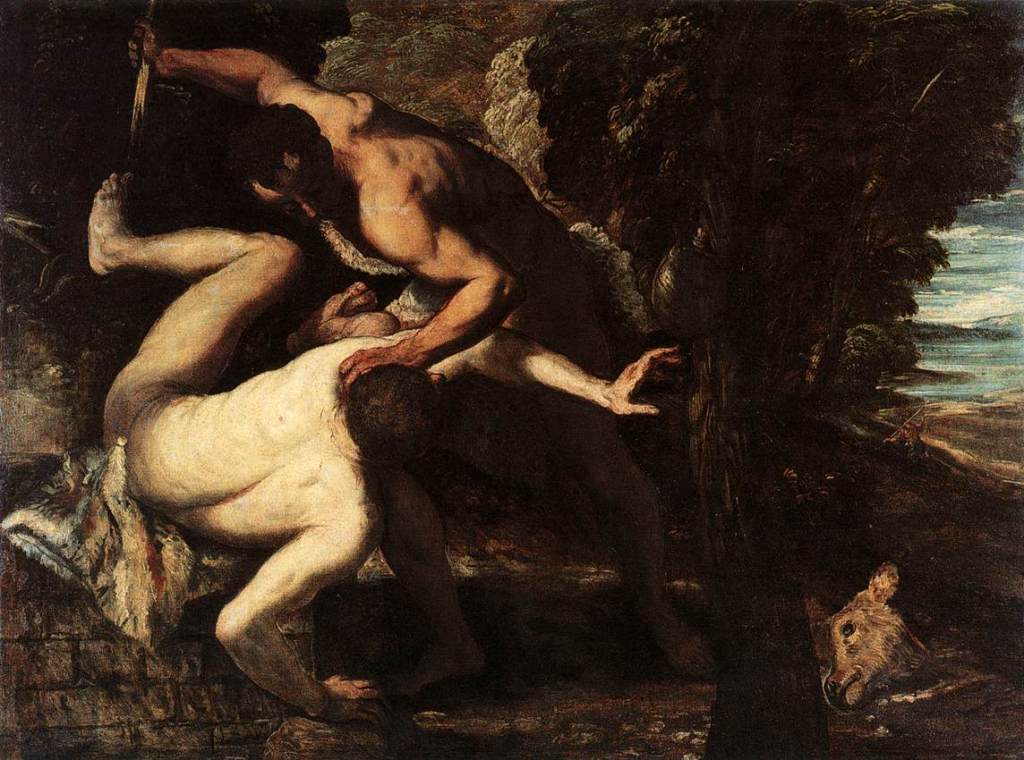
Then Cain did something I at first took to be of a helping intention; he, with his long strong arm, reached into his brother’s sack, and took from within it the knife Abel used to cut the sheep’s throats, after which a moment of awful silence followed. Still Abel investigated the animal with wonder, whereas Cain, trembling violently, threw the sack aside, and grabbed a fistful of his brother’s curly hair. At this I heard myself break into a sound that, by seeing Cain wrestle his struggling brother backwards, rang through the fields, although no one but myself heard it. Then Cain forced the knife to Abel’s throat, which he sliced open, so that a great crimson spray of blood wetted the dry earth. I felt as if I was about to collapse as I saw it, but by some miracle I am as of yet to identify, I managed to stand upright, leaning against the great bush, while I watched in horror as Cain held his little brother, tightly, so tightly in his arms, as his (Abel’s) life faded.
If I thought the silence before had been awful, what followed was something I am never to forget. I could neither move nor speak, and I felt, as I held on to the honeysuckle branchlets, that I was never to do either again. Cain had risen and he stood looking about him, trembling so intensely I saw him fit to collapse before I would. Then he bent over his brother in much the same way Abel had bent over the dead sheep, and he stood for a bit, and then, by what looked to be an irresistible convulsion, dropped on his knees before his little brother, and hid his face on Abel’s chest.
I don’t presume he was praying; rather, he was still shaking — shaking all over. It was not for some ten minutes, in which I myself was froze to the spot, that Cain rose from his knees, and even as he stood upright his trembling and crying had not yet subsided. Then he wiped the tears from his very brown, very lean, very sharp cheekbones, and threw the knife still with much blood on it into the trees. Yet another interval followed, where he stood, looking at his dead brother with eyes, I might add, that seemed not to see at all, but rather to be turned inward, ransacking himself.
Thinking of it now, so many years later, so many miles from the land east of Eden, I find myself full of the customary habits of sorrow, of which I mistakenly have thought would give away to time (they haven’t), and of which there is little to do — it is a sharp ache, it is enough to make my very soul go cold. Sometimes it is very bad, even moreso when I think of that abrupt ending; how Cain bent over Abel and, still crying, took his little brother by his bloody feet, and dragged him into the trees; their figures receding and receding, until I was never to see them again. So quickly did it all start and so quickly did it all end.
It was after a very long time, so long I think the sun was to set, that I with an uncontrollable (a psychoanalyst had later called it an insatiable), a really, if one would, outrageous curiosity, had followed the bloody trail into the trees. The same psychoanalyst, though I had seen many, had in a fit of revelation mentioned that this part of the story was particularly telling, not in illuminating scripture, but rather in illuminating me.
In the shadow of the tall trees which stood like brooms inverted I looked and looked for the body of Cain; I searched, I called, I dawdled; above all I waited as if I would somehow come to see him again. As if (pardon me) he would resurrect. I did not on the spot see the trap that I should later know, and come to know very well.
“Oh, so he was not there,” was what the psychoanalyst had said.
“No,” I replied, “he wasn’t.”
“Just gone?” asked the local administration in Nod.
“And never to return,” I said, falling into the enquiry.
“What an —” and the journalist (or intern) had looked hesitant, “ending.”
“Yes,” was my weak answer.
Later, of course, I heard of the offering; of The Governance’s refusal of Cain’s gift, and the great pleasure he took in Abel’s. Cain, it proved, was to be the most famous person in that part of the world and, for the time being; he is Cain because he has murdered his little brother, whereas I think it should have been, for anything like a good, long-lasting legacy, that he is Abel’s big brother because he is Cain.
But that was not what happened.
It may seem peculiar to the reader, but as for the murder of Abel, there is little more to be said; and, to be fair, scripture albeit its details are rather deficient, rather sparse, is somewhat right in what happened that terrible day. I wanted to tell my story unfiltered, as that is the only story I know. And that story is, I dare say, enough.
Written by Oliver Marcell Bjerregaard.
For the full story: find the contact information on the home page.

 Paradiso
Leave a comment