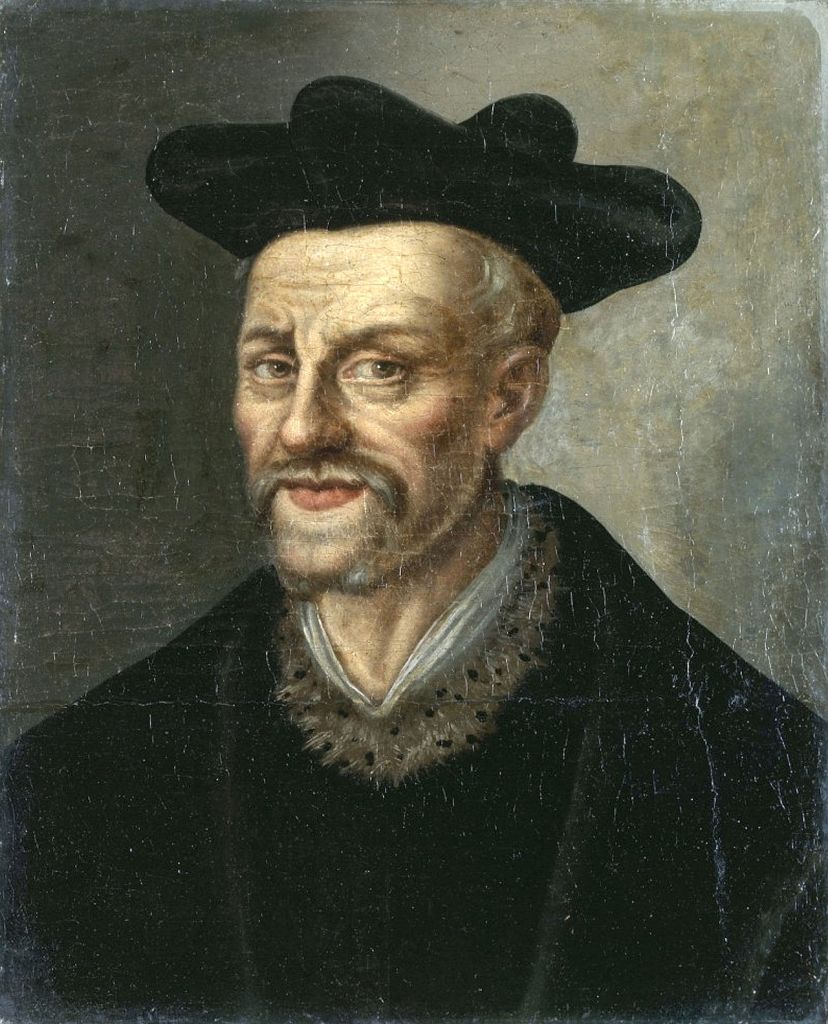
While many have read (and studied) French literary giants such as Montaigne, Molière, Flaubert, Rimbaud, Baudelaire, Proust, etc. it is easy to forget that there is a single pioneer within the French language (and in literary history in general) who came before them all, and who, like Chaucer is for Shakespeare, and the English literary establishment, so is Rabelais for the French.
Rabelais’ magnum opus ‘Gargantua and Pantagruel’ is as many-layered, nuanced and complex as any of the Great Difficult Works written in our canon, and as it happens, one of the earliest of its kind with Chaucer, Boccaccio, and possibly de Rojas too.
It is a work that aside from being utterly hilarious, and a satire unmatched, finds itself — more or less — incomparable. It fits the criteria Harold Bloom has set up for works that have entered his Western Canon. I.e: works that transforms language, works that are of the highest aesthetic order, and, works of imaginative superiority. Considering these factors, Gargantua and Pantagruel is among the greatest works in world literary history, rivalled only by Shakespeare’s greatest plays and Dante’s Divine Comedy.
It is a Ulyssean (Joycean) feast of language, comedy, philosophy, political theory, rebellion and a wittiness that before Rabelais was expressed only subtly, or in the case of an Ovid or Chaucer; if not subtly, then delicately; less, shall we say scatological in its nature. Rabelais was on more than one occasion read aloud in the royal French court — stunning everyone present by its extreme obscenities. Satire especially is at the heart of Gargantua and Pantagruel. One cannot help but think of Erasmus’ In Praise Of Folly, which was a big source of inspiration for Rabelais. And no doubt later satirists such as Alexander Pope whose body of work include ‘The Rape Of Lock’ and ‘The Dunciad’, two monumental satirist pieces, no doubt was inspired, and influenced, by Rabelais.
Rabelisian is literally defined (by Oxford: New English dictionary) as: “an exuberance of imagination and language, combined with extravagance and coarseness of humour and satire.”
Can a writer receive higher praise than this?
As M. A. Screech points out: “Chateaubriand classes Rabelais with Dante, Homer and Shakespeare as a genius who gave suck to all the others (…) he was read by Bacon, Molière, Diderot, Balzac and dozens of other giants.” I cannot help but agree. Rabelais’ influence is vast and perplexing. And often overlooked.
It will take the reader a while to get through Gargantua and Pantagruel from start to finish. In the beginning, one is advised to read it in sections, and only later read it from A to Z, as the content within the work, the sheer erudite nature of the project, requires deep introspection, and at times hours of looking up both philosophical and historical references. There are passages of such comedic greatness and strange beauty that I have had to (on several occasions) just sit for a while with the text open in front of me. Overwhelmed; trying to catch my breath, thinking, thinking. . . Then, breaking into what I figure is a rather ludicrous smile, continue reading. Or, let what I have read sit with me for the day. Moving on to other projects.
Like the works of Montaigne, Dickinson or Shakespeare, Rabelais is as deep and complex as anything you are likely to read. He is not merely a comedic genius; he is exuberant in every facet, and as provoking in thought as anything I have read –– A cognitive contribution, essentially unrivalled.
I will disagree with my mentor prof. Harold Bloom here on one point. Within his core 26 authors in the Western Canon we find three of French descent — and no, not Rabelais. While Montaigne is for me the greatest of French writers, and I agree in essence that Molière and Proust belong on the list too; however having left out Rabelais is a mystery to me. Possibly inappropriate.
The 26 writers are:
Shakespeare, Dante, Chaucer, Cervantes, Montaigne, Molière, Milton, Samuel Johnson, Goethe, Wordsworth, Austen, Whitman, Dickinson, Dickens, George Eliot, Tolstoy, Ibsen, Freud, Proust, Joyce, Woolf, Kafka, Borges, Neruda, Pessoa, Beckett.
It is obvious that the magnificent writers above are all essential, crucial, and they have contributed to human cognition, far beyond their peers. But there are adjustments one can make. And not including the likes of Rabelais is one such adjustment I would have to discuss with prof. Bloom should I be so lucky to meet him again in The Big Mix.

 Paradiso
Leave a comment