
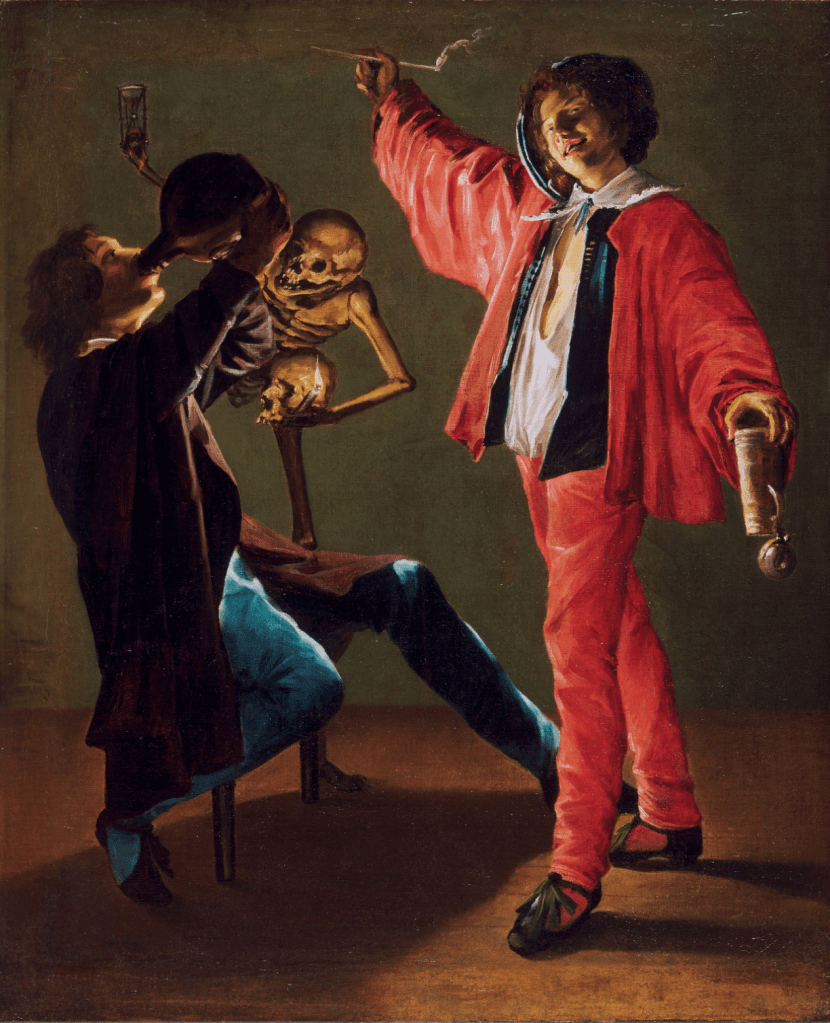
It is no coincidence I have chosen Dutch painter Judith Leyster’s The Last Drop as the “pictorial reference”, as it were, for this crucial issue of which I am, at long last, about to expound. I touched on this in my Walt Whitman essay and later in my commentary on King Lear; but, what instigated this post was a chat with a friend who had recently partaken in two philosophy courses on the university, and he told me—to my great distress—how he was taught Hegel’s quote: “dialectic method”. A method to which many have associated Hegel’s system, a triad (hence Leyster’s painting) that has, unfortunately, truly bastardised Hegel more than it has contributed to a fundamental understanding of the Hegelian principles.
Having read Hegel’s corpus of major works (and what has been considered his non-major works) not only through English translation, but in German as well; and, having been fortunate to write my Master’s thesis on Hegel’s exceptional Wissenschaft der Logik, or The Science of Logic, often referred to as the Logic, an often neglected work, despite it being his true masterpiece, I dare say, I have been in the Hegelian trenches for years. Not only was I fortunate to write my Master’s in Hegel’s Logic, but I had as my mentor Danish philosopher Poul Lübcke as well as Peter Busch-Larsen (the latter tutored me privately in Hegel); both of whom were with me the entire way, scrutinising my work on Hegel with old-school, fist-raised, tough-love academic rigour.
I think most are familiar with the “Triad”, as it is often referred to, which is taught—typically—as a ladder or a staircase,
Thesis ->
Antithesis ->
Synthesis ->
New thesis ->
Et cætera. . .
This is how, more often than not, even at the highest academic institutions, Hegelian dialectic is being presented, interpreted, even worse: taught. It essentially postulates that whenever we have a given thesis, this thesis will inherently have an antithesis, and as the two of them are in “conflict”, as it were, it leads us to a synthesis, which in turn is a new thesis. It is important to note that not only did Hegel not come up with this idea (it was actually invented by Johann Gottlieb Fichte), but Hegel criticised it heavily, going so far as to call it a “lifeless scheme” and a “Schattenspiel“, meaning a “shadow-play”. Attributing the Triad to Hegel originates in part from the extreme difficulty of understanding the Logic, and in part with philosopher Heinrich Moritz Chalybäus, who, for the sake of simplifying the Hegelian method (one wonders if he ever seriously wrestled with the Logic, one can doubt it. . .), attempted to simplify the Hegelian method for the broader audience. What has happened, though, is a persistent misinterpretation of Hegel’s system, which, in the Logic, as I will attempt to show, reveals an entirely different structure.
Fürsichsein (being-for-self/being-for-itself) the first step to the shattering the Triad:
I am allowing the argument to start a few steps past Hegel’s initial discussion of Pure Being, and instead starting at the point of Being (“Dasein“) or Determinate Being, which, to keep alive at the back of your mind is: Being + Nothing = Dasein. For the sake of simplifying an already challenging topic, I will start at Being as our immediate point, rather like Joyce in Finnegan’s Wake had to begin with his fantastic,
“riverrun, past Eve and Adam’s, from swerve of shore to bend of bay, brings us by a commodius vicus of recirculation back to Howth Castle and Environs.”
One of the most important aspects of the Hegelian system is that Being (“Dasein“) is constituted by its Something (“Etwas“) and its Other/Negation (“Anderes“), meaning, in a sense, Something is only Something when seen through the lens of its Other, its Negation/Something Else, as it were. Take the simple text-book example of: love is by definition only love because of its negation hate and vice-versa. With Fürsichsein, however, it is revealed that the Other or the Negation, is revealed to be the Something’s self. The Other/Negation is Sublated (“Aufgehoben“) in the Something, and returns to the Something. It does not create a new “Something,” or, synthesis (i.e. the conclusive element in the Triad).
We’re not talking about a Linear A+B=C, C+D=E, et cætera. No, we’re talking about a circular, immanent return to Something—think of Finnegan’s Wake or Dahlgren—or, think of Spinoza’s omnis determinatio est negatio.
Let us boil it down:
I. Something realises that its Negation/Other is itself: The two are at once Identical and Different.
II. Aufhebung: Something, in a sense, reclaims its Negation/Other (which, remember, is itself) as its moment. But, it is important to state: nothing can be “reclaimed” that has always-already been there in the first place, so the Negation/Other is both being reclaimed and not reclaimed. Hegel calls this presupposing (“Voraussetzen“).
III. The return: The Negation/Other is seen to be “the other of itself” or, “das Andere seiner selbst.” When the “Something” relates to this Negation/Other, it is actually relating to itself. For, they are, at once, the same, and not the same.
(This is of great importance to keep in mind as we continue).
It should be clear where the Triad model fail so fantastically as it implies a chronological order: I->II->III. However, it is not, and never was, a combination or a sort of “mix”—a synthesis; it is, rather, the recognition that the very thing that makes Something what it is, its identity, is exactly its boundary against what it is not, its negation.
Reflection-into-self:
In this moment or stage, we see there never was a third thing to begin with: only the movement of the Negation itself. It is this Hegel later calls self-movement (“selbst-bewegung“), meaning, the Notion/Something moves on its own through the Negation. Notions can therefore be self-moving; it is a movement between A-B, and not through any additional building block, e.g: synthesis.
So, Dasein/Being as seen above is Sublated (“aufhebung“), and we are moving to a new area now of Identity and Difference. I have already alluded to this above, as Something has realised its Negation is both identical to itself, yet, it is different.
Hegel reveals that the other is, fundamentally, a “Schein” (like a first-layer/outer shine, but better translated/interpreted as an illusion or a sort of “deceivement“, if I may). Reflection-into-self follows much the same process as Fürsichsein: it is the realisation that the Negation/Other is but a reflection of the Something.
It can be summed up to something like Lacan’s mirror stage (which is, as it happens, derived from the Hegelian system):
The child/Something looks into the mirror and sees its Negation/Other. Mind you, the image has fundamentally no independent existence: yet, it is and is not the child. The interesting thing is that the child/Something will pretend to be its reflection/Negation, but, as it recognises itself in B, it returns, at some stage, to itself/Something, but now as a self-related unity. The child, in very real way, needs the reflection/Negation to achieve a sense of its own totality—even though that image is, at its core, a “Schein” (an illusion/decievement).
Von Nichts zu Nichts
. . . or, from Nothing to Nothing. This is a crucial moment to understand. Let us continue to build on Lacan’s mirror-stage (forgive me, I do interpret a bit on the Lacanian Idea to fit the Hegelian system).
The child’s reflection/Negation in the mirror is, in a sense, well, nothing. It has no independent existence. Yet, the child is nothing as well, that is to say, nothing without its reflection (the use of reflection here has a double meaning: reflection [thought] and physical reflection [mirror]. . .). The self-movement mentioned earlier (“Selbst-bewegung“) comes into play again: it is the process of this nothing/Negation relating to itself. Notice how there is no third element, that is to say, you cannot add two nothings to get Something. To quote King Lear: “nothing will come of nothing.” (1.1). You only have the relational, the movement between the two “nothing’s”. The child is only the child because it is not its reflection, yet, it is only the child because it is the reflection. Notice the movement between the child and its reflection. We are not introducing any third factor, but stay within the confines of this circular motion.
This leads Hegel to Der Grund, a beautiful, rather satisfying state. If the moment above of Reflection-Into-Self was the Lacanian mirror stage, then Der Grund is the striking realisation that the Child and the Mirror are the very same thing—or the same content. Der Grund is the unity of Identity and Difference.
The child/Something looks for itself in its Negation/Other, only to find that the child/Something is just the child/Something reflected. It is at this moment when self-movement (Selbst-Bewegung) realises that it is its own foundation. It is the Absolute Identity of both the Identity and Non-Identity moving among one another in a constant tension and relxation.
Let us illuminate at the last part of Hegel’s logic in this very brief, very diluted issue of Hegelian logic in order to completely shatter the myth of the Fichtean Triad—we are getting to the point of Philosophy of Nature, when, to continue with Lacan’s analogy, the child, as it were, metaphorically steps through the mirror. Hegel writes of a Release, or a Free Release (“Freie Entlassung“). The Logic, or child/Something, has now become so sure of itself through the Absolute Identity mentioned above, that it no longer needs to reflect on Nothing. It lets itself go; and, it does so freely, into (“Aussereinandersein“) or Extraneity. Nature is therefore the Concept of: “outside of itself.” Note how we have not arrived at a new state (a Synthesis), rather, it is the logic in a different state of Being-Other, or, Being-Itself.
We then approach the very end, a beautiful, elegant, and distinctly magnificent end, if you ask me. It is The Return to Spirit or Geist (think of Hegel’s Phenomenology); it is, as it is often said, now we see the circles of circles of circles. . . The Logic returns, like Finnegan’s Wake, to the very beginning.
The very mechanism behind this is the extraordinary process of the Negation of the Negation. Let me explain this with Lacan’s mirror-stage as the mediator. The child, at first, as seen above, negates its immediacy by seeing its Negation/Other in the mirror. This is the first negation of the process. The Child then negates the otherness (“Andersheit“) of its own reflection, which represents the second negation. This process does not lead back to a simple Something (e.g: the child), but to a negative unity* that is self-related. It is at this moment when the Something, in our case the Lacanian Child, via the Negation of the Negation, shows how it is “in seinem Anderen bei sich selbst zu sein” that is to say: to be at home with oneself in one’s other. It is therefore not merely a circular trip (well, it is and it isn’t) but at its core an achievement of freedom between the two through the movement between the two, which, is a constant.
*Mind you: Negative unity is not meant as negative as a quote: “bad thing”. Rather, it is the concrete (conveyed) growing together with the abstract (immediate). It is the internal development of a single thing, not a synthesis which implies the mixing of two separate things.
Hegel essentially tells the reader that the Absolute Idea has no other content other than the entire path one has just walked through the Logic’s some 1000+ dense pages—or, to put it differently, that the child or You, have no other existence than the movement (the self-movement) between yourself and your negation.
Let me stress this crucial point once more: The Absolute Idea, for Hegel, is not a clear-cut, Chalybäuserian answer such as The Triad, nor anything else that can be put into a simple equation, rather, The Absolute Idea is the Process itself, or, the Method. I.e: the movement, or, self-movement. Each step or moment in the Hegelian method is not about adding “new layers” or “bricks”, if you will, it is about the self-movement becoming visible, or concrete (contrary to immediate. . .).
Never think of it as a before and after, like the Triad does, instead think of it like Finnegan’s Wake, that the project is presupposing what is already there (“Voraussetzen“).
I hope this shows how The Triad is a logical impossibility in Hegel’s system.

 Paradiso
Leave a comment