The essays on this blog has, thus far, been singularly analytical in their approach as far as the works dissected, from Shakespeare to Dickinson, from Rabelais to Whitman, from Nabokov to Montaigne. However, as many of these essays takes much time and effort, I have had in mind for some time about posting (in between larger, more comprehensive essays) smaller reflective posts, possibly of a more unstructured nature, on works I have read, or I am in the process of reading.
Recently I finished Goethe’s Faust part 1 and part 2, and Ibsen’s A Doll’s House and his verse drama Peer Gynt, somewhat at the same time. Three (or four if you will) extraordinary plays within the Western Canon, quite different in their aesthetic makeup, and equally different as it pertains to the subject matter at hand; yet, similar in that all four works are getting at the very core of human existence, and, as it happens, they are (almost) perfect expressions of artistic and aesthetic value of the highest merit.
Faust
Starting with Faust part 1 and part 2, both of which are recognized as two of the greatest, and most well-studied plays in world literature. Hence, finding a linear synopsis on the content is a rather simple task (for those who are yet to read the play), especially in this age of hyperinformation, so instead of such futile task as outlining the story chronologically, I’d rather like to highlight and delve into specific passages from Faust part 1, as part 2 needs a separate, long-format essay, in which I found interesting, cross-connectional influences with other playwrights and poets.
Book of Job
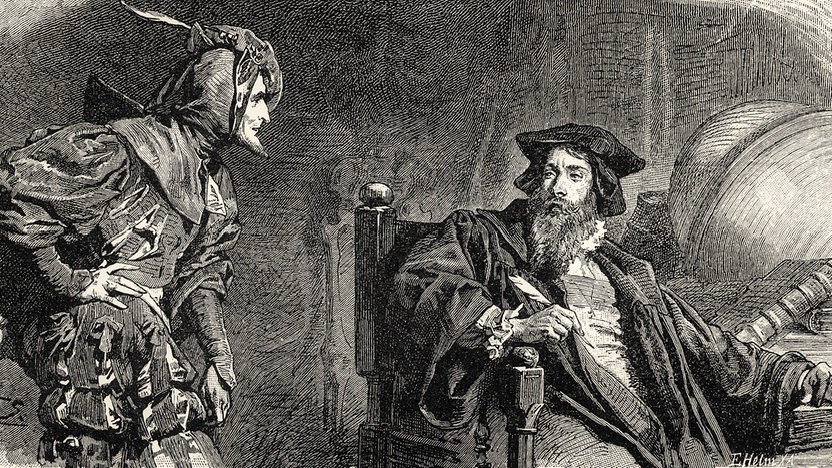
The first, and rather obvious external influence is The Book of Job, excellently reimagined in Faust’s prologue, when Mephistopheles, a demon who is acting as the Devil’s servant (or possibly Shakespeare’s as we will later see), complaints to The Lord about the human race and its deficiencies. Mephistopheles does so in an act of obvious provocation; a bait The Lord, rather ironically, cannot help but fall for (think the fall), giving the reader clear reminiscences of the The Old Testament god, Yahweh, who portraits man as much as man portraits Yahweh: an entity/personage who is at times angry, jealous, egoistic, competitive, manipulative, and selfish beyond measure.
From Faust part 1:
Mephistopheles:
The suns and planets are no theme for me.
How human beings torment themselves, that’s all I see.
(…)
He calls it reason and uses it
Only to be more bestial than any beast.
(…)
If only he would bide quiet in the grass!
Not poke his nose in every mess.
This provoking statement, or critique if you will, on The Lord’s finest creation (human beings) has The Lord promptly triggered,
The Lord:
Do you have nothing else to say to me?
And never come but finding fault always?
Never a thing on earth gives you content?
Then The Lord asks if Mephistopheles knows Dr. Faustus, The Lord’s “servant”, a man Mephistopheles knows, and has this to say of,
Mephistopheles:
Indeed! His way of serving you is odd.
His meat and drink are not the earthly sort.
The ferment in him drives him ever further,
He’s half aware that he is raving mad,
From heaven he wants the fairest star
And from the earth then every highest pleasure
And all things near and all things far
Can’t satisfy his foolish deeply agitated heart.
Faust is indeed going mad as the reader will later see, as Faust feels betrayed by all the sciences; none of which will provide him with the great, limitless pleasure he so desperately seeks, making him an easy target for Mephistopheles, and as it happens, though in perverse reversal, for The Lord as well. Mephistopheles proceeds to provoke The Lord in order to get the ‘permission‘ such permission as a devil needs, to make a Jobian bet concerning Faust,
Mephistopheles:
What do you wager? Lord, allow me
Gently to lead him where I will,
I promise you that you will lose him still.
To which The Lord responds,
The Lord:
(…)
Grasp him, if you are able to,
And leaf him with you on your downward course,
And stand ashamed when you are forced to recognize
A good man, though impelled in darkness, yet
Is well aware of what the right way is.
The premise then, is the Jobian one: can Mephistopheles push Faust to such a degree that he (Faust) will no longer recognize right from wrong? Can Mephistopheles truly cloud Faust’s soul? Hence, the Faustian Bargain in which Mephistopheles will seek to provide the limitless pleasure Faust so urgently seeks, on the condition, should Faust gain his moment of limitless pleasure, he must help Mephistopheles in the realm of death.
It is a prospect that is as scary as it is wildly fascinating. We shall later see much of the same bargain when Peer Gynt meets A Strange Passenger in Ibsen’s verse drama, who is a collector of souls, and wants to make a deal with Peer to take his corpse to discover the origin of dreams.
Shakespeare
Another obvious influence on Goethe is Shakespeare, who, for any avid Shakespeare reader, appears often and persistently during the play, linguistically as well as in the implicit (or explicit) psychological ramifications for several, if not most of the major characters. Goethe rightfully understood, as did many of our greatest writers and playwrights post-Shakespeare (Ibsen, Beckett, Austen, Dickens, Joyce, Faulkner, etc.) that one must wrestle with Shakespeare, that is to say the canon, in order to provoke greatness. For Goethe especially, Shakespeare was the eminent precursor, one Goethe could allow as his superior forerunner as the two of them were writing in different languages.
Goethe was intimate with Shakespeare’s works and he addressed Shakespeare in several of his essays with awe and wonderment. In his Literary Criticism (1771) he writes:
‘The first page I read made me a slave to Shakespeare for life. And when I finished reading the first drama, I stood there like a man blind from birth.’
And later in his Shakespeare Once Again (1815) he discusses how Shakespeare achieved what in literature is the highest of goals, which is to truly know one’s self. This is what prof. Harold Bloom points out in Shakespeare: The Invention of the Human (1998) when he distinguishes between the Shakespearean tree, i.e self-reflection and one’s ability to overhear and talk to one’s self in order to reach self-actualisation, contrasting it with the Cervantean-tree in which self-actualisation comes about through dialogue and talking to one another.
Finally, Goethe in his Maxims and Reflections (1833) says of Shakespeare:
‘Shakespeare is rich in wonderful tropes which stem from personified concepts and which would not suit us at all, but which in him are perfectly in place because in his time all art was dominated by allegory.‘
As for Faust Part 1, Shakespeare is the ever-looming presence. Mephistopheles, the demon, is as calculated and cynical as Othello’s Iago or Lear’s Edmund. Both are incarnations of the cold, psychopathological tendencies often seen within the worst of our villains, or even in protagonists of extreme cunning like Ibsen’s Hedda in Hedda Gabler, who, like Iago, Edmund, and Mephistopheles are engines of negation and havoc. They seem to find a sinister enjoyment in ruining and toying with people’s lives; they are the writers who writes their fellow characters lives. Mephistopheles is, one could say, not merely the messenger of the Devil, bur rather the messenger of Iago and Edmund.
Faust himself, represents the Shakespearean tradition of overhearing one’s self; to talk to one’s self, and in the case of Dr. Faust, he is the direct descendant of Hamlet, and later the inspiration (with Hamlet) for Peer Gynt. Though Faust is not as self-reflective, or clever as Hamlet or Peer Gynt, all three characters are presented with the same profound existential crises, leading them on paths to deep self-discovery and ultimately self-destruction. Although for Faust, it ends up an earthly one, as his soul, at the end of part 2 is saved by The Lord in a strange move by Goethe I still find dubious.
Lest we forget, as far as similarities goes, that all three characters are in direct contact with the supernatural: Hamlet with his father’s Ghost, Faust with the demon Mephistopheles, and Peer Gynt with one extraordinary supernatural invention after the other.
As for a few additional Shakespearean associations which came across rather immediately upon reading Faust. First, from Faust part 1, §1678 is the line spoken by Faust himself:
‘But do you have food that leaves the eater hungry (…)’
This will instantly remind the reader of King Lear, in which Lear refers to his daughters as vultures, and he later portraits the rather terrifying idea of the creature which feeds on what makes it hungrier.
Another example in Faust part 1, is §1064-1065 when Faust says,
‘I call him happy who still hopes to rise
To the surface in this sea of error.‘
Upon reading these two beautiful lines, which are part of a larger Hamlet-like monologue from Faust, it is indeed Hamlet who is revoked for the avid Shakespearean reader, when Hamlet in his excellent monologue §64-68 proclaims,
‘To be or not to be — that is the question:
Whether ’tis nobler in the mind to suffer
The slings and arrows of outrageous fortune,
Or take arms against a sea of troubles
And, by opposing them, end them.‘
§67 especially: ‘Or take arms against a sea of troubles‘; is a direct Shakespearean inspiration to Goethe’s ‘To the surface in this sea of error.’
At the end of the play in §3710, Faust and Mephistopheles are in a deadly sword fight with Gretchen’s brother Valentin, which reminds the reader rather uncannily of the fight between the brothers Edmund and Edgar in King Lear; though, in Faust, the fight is darkly played out for the reader, or, depending on the medium with which one consumes Faust, the viewer.
Milton
There are certainly other fascinating references in Goethe’s Faust part 1, often, I was reminded rather eerily of Milton’s Paradise Lost in which the character of Satan simmered to the surface. First (and most strikingly), in §1780-84 when Mephistopheles is talking to Faust about himself and his ‘kin’,
Mephistopheles:
‘Believe me and my kin:
This whole is only for a god.
He dwells eternally in light,
Us he consigned to darkness, you
All you are fit for’s day and night.‘
§1783 is especially intriguing: ‘Us he [The Lord] consigned to darkness‘ which is, even if Goethe does not want to admit to it, a rather enigmatic and direct inspiration from Paradise Lost, when Satan broods with his kin, particularly Beëlzebub, in hell, about them being consigned to the dark underworld, §84-105:
‘If thou beest he–but O how fallen! how changed
From him who, in the happy realms of light
Clothed with transcendent brightness, didst outshine
Myriads, though bright!–if he whom mutual league,
United thoughts and counsels, equal hope
And hazard in the glorious enterprise
Joined with me once, now misery hath joined
In equal ruin; into what pit thou seest
From what height fallen: so much the stronger proved
He with his thunder; and till then who knew
The force of those dire arms? Yet not for those,
Nor what the potent Victor in his rage
Can else inflict, do I repent, or change,
Though changed in outward lustre, that fixed mind,
And high disdain from sense of injured merit,
That with the Mightiest raised me to contend,
And to the fierce contentions brought along
Innumerable force of Spirits armed,
That durst dislike his reign, and, me preferring,
His utmost power with adverse power opposed
In dubious battle on the plains of Heaven,
And shook his throne.‘
Another obvious link with Paradise Lost are the similarities, or should I say dissimilarities, between Goethe’s Mephistopheles and Milton’s Satan. It is undoubtedly Goethe’s take on a more true Shakespearean her of tragicomedy in Mephistopheles, contrary to Milton’s poetic figure of Satan. Where Milton’s Satan is of a more aggressive and manipulative (almost attractive, appealing) nature, Goethe’s Mephistopheles is more humours, cunning, dry, and the archetypical ‘snake in disguise’. Though both are very complicated figures, Mephistopheles‘ appeal lies within his almost-human mannerisms and laid-back nature.
Mephistopheles seems to us familiar and known, whereas Milton’s Satan is a more distant, somewhat detached figure.
There are certainly more fascinating inspirations looming in Faust part 1: Ovid’s Metamorphosis, Dante’s Beatrice, and Cervante’s Don Quixote; with a specific reference to when Faust and his assistant Wagner sees the black poodle (Mephistopheles), and Wagner — like Quixote’s Sancho Panza when Quixote storms the windmills he takes for giants — tells Faust that what he sees is but a black poodle,
Wagner:
All I see is a black poodle. Fore sure,
With you this is some optical illusion.
As a final remark, or question, in this sporadic, rather incoherent rambling of reflections: what is, truly, Faust’s tragedy in this two-part tragedy?
It is a difficult question although the answer could possibly be distilled to something very simple, but extraordinarily complex. It is his salvation. It is that Faust never truly experiences, or perhaps can experience tragedy. This will later be explored fully in an essay on Faust part 2, however, much of what Faust’s tragedy is — or isn’t, happens to be illuminated excellently by Ibsen in Peer Gynt.
Ibsen
The following reflections on Peer Gynt will be rather short as I intend to explore this excellent character later, contrasting him with the characters we find in Shakespeare, Molière, Tolstoy and Dickens, four of our greatest writers as it pertains to literary imaginings. Further, Peer Gynt has to be compared at a later stage to that of Faust part 2 in which one finds a wonderful contrast in how two extraordinary authors utilise the power of mythology; Goethe, almost to a fault, as his mythos hardly translates well to the stage (or so is the feeling when reading Faust part 2, despite all its splendour and poetic superiority), whereas Ibsen managed to use Norwegian Folk Mythology expertly, and as we shall see, stage-wise: convincingly.
Peer Gynt is, on the surface, an unlikely candidate to be held up against exuberant characters such as Alceste (The Misanthrope), Hamlet (Hamlet), Don Quixote (Don Quixote), or Scrooge (A Christmas Carol), because who is Peer Gynt, but a sham poet, perpetual procrastinator, and boyish idler, who idealises himself to an almost absurd degree — or so is the immediate interpretation. Like the Biblical Yahweh, or Harold Bloom’s notorious example of Falstaff, or even to an extent (although I am confessedly still pondering this one) Mephistopheles, there is no reducing or dismissing these characters to any degree of moralistic nor ideological simplicity.
Because Peer Gynt is, like the above-mentioned characters, a fully realised self. Despite his flaws and his often unlikable nature, he, like Falstaff, to quote Bloom: “justifies his every fault, mitigates his life, until we reflect upon it; and who has time for such reflection while Falstaff is on stage?” (The Western Canon, 1994). Peer Gynt represents universalism of character, of psychology, of our self’s journey toward self-discovery; and he is, to draw upon Bloom again, a phenomenon of wildness, exuberance, and pure “vitalism”. A characterisation I greatly appreciate.
In other words, Peer Gynt is us, and we are him. Gynt resists our judgements. With Gynt, we the readers are the one’s being perpetually judged, which becomes clearer as the verse drama unfolds slowly and intimately. This is the very core of our greatest characters in literature. We can hardly psychoanalyse these wild and inventive phenomenons, rather, they analyse us. It is with them we can critique our self’s, it is with them we can illuminate our ideologies; not the other way around.
Peer Gynt
The verse drama begins with Peer Gynt lying to his old mother, essentially retelling an old Norwegian legend as a coverup for him hunting wild game, setting the stage for what Gynt (currently) truly is: a fraud. Further, it is clear Gynt suffers from serious self-illusions of grandeur, as he thinks himself meant for an extraordinary life, telling his mother confidently he will one day become an emperor of all things:
Peer: (…)
Wait till I bring about
something truly great!
Aase [snorts]:
You? Great?
Peer: Who knows what I might meet?
Aase: I wish you had sufficient wit
that – just once! – you might mend
the rip in your own nether end.
Peer [becoming excited]:
I shall be emperor! A king!
This should instantly remind the sturdy reader of Don Quixote, in which we see early in chapter 1 our dear Quixote being wildly inflicted by the same illusions of grandeur from having read his countless books on chivalry,
“The poor man could already see himself being crowned Emperor of Trebizond.” (Don Quixote, 2000)
Later in act one, Peer anticipates himself dying a noble death, when he takes his protesting mother to Hæggstad to see the bride, Ingrid, whom Peer could have had if he had chosen her, wed his rival Mads Moen,
Aase: More like we’ll both drown.
Peer: For something better I was born,
a nobler death!
Still, ones sympathises with Gynt’s rather ludicrous illusions (like one sympathises with Quixote), and however unreal his visions are, they (the visions) are themselves part of the vitality with which Gynt develops and transforms not just his own consciousness through his many travels, which fills most of the acts, but the reader’s consciousness as well. It is fascinating to see Gynt, from Act I to Act V: from a young a man who is unstoppable and full of energy; fighting with trolls and his neighbours, to becoming a slave-trader and taking company with the corrupt and the criminal; travelling from Morocco through the Saharan Desert to a madhouse in Cairo. Bloom’s summarisation is excellent:
“The hero of the first three acts is now more clearly a hero-villain, but he is also consistently funnier and even more likable, because his rueful misadventures touch so tellingly on a universal strain in human fantasies. Knowing still that he somehow remains elect, the scamp Peer clambers up a tree, where we see him fighting off monkeys as if they were so many trolls. With his customary insouciance he next wanders through the desert and meditates on improving it. Peer, we suddenly see, is the link between Goethe’s Faust and Joyce’s Poldy Bloom.” (The Western Canon, 1994)
However, in act V, upon returning home shipwrecked, pitiful, grumpy, and is faced with everything he never got to do, Gynt ends up exactly the pitiful human being he thought he was not destined to be. In a Hamlet-like monologue in act V, Gynt confesses:
Peer: (…)
You old fool, though!
You’re not an emperor; you’re an onion,
in need of peeling, my friend Peer.
You can weep all you like; it still has to be done.
[Picks an onion and begins to peel it.]
The full monologue of scene 5, act V is about two pages, and it gives reminiscences to King Lear’s transformation of his hitherto warped and one could say rather archaic self-consciousness, though Gynt never quite transforms to the degree Lear does until the very end.
Later, in scene 7, act V, Gynt is confronted with the hilarious Button-Moulder, a curiously patient entity, whose job it is to mould Gynt’s soul with faulty goods,
Button Moulder: Peer Gynt. I call
that luck! For I am to meet you here
this very night.
Peer: Are you indeed? And why the need?
Button Moulder: You’re to go in this ladle o’mine.
Peer: And to what end?
Button Moulder: To be melted down.
Peer: Melted?
And later in scene 7, the Button Moulder says, rather stunningly:
Button Moulder: The process dates back to the first
creation
of living things; and is an essential link
in the grand economy. You’ll have a fair notion
of what I mean: you could trim a button mould
in your young days. Many castings are spoiled;
sometimes a button is without its shank.
What did you do with the spoiled button?
At the end of scene 7, Peer protests and refuses to give up his soul, to which the Button Moulder answers,
Button Moulder: (…)
You’re not eternal enough for heaven.
And Peer Gynt answers with another wonderful Hamlet-like monologue, essentially agreeing he is not worthy for heaven, but, nor has his sins been bad enough to warrant eternal torture, and he ends up replying, famously:
Peer: (…)
This is what angers,
this is what makes my innermost self rebel!
To which the Button Moulder replies with one of the greatest responses in the canon of Ibsen,
Button Moulder: My dear sir, you’ve no call
to make such protests. Never in the past,
even for a moment, have you been yourself,
so what does it matter? And on whose behalf
do you bewail this lost identity?
Peer: Have not I been? I weep with merriment.
Something else he has been – that’s it? – this fellow Gynt?
No, button moulder, you stand in blind judgement
against me. Could you but see into my heart and soul
you would discover
Peer, Peer, the one and only Peer,
the irreducible entity
indissoluble to mere quantity.
It is exactly Peer’s response which leads the reader to see how, despite his self-realisations, he has not reached the self-consciousness of Lear or Hamlet or even Don Quixote at the end of Don Quixote. Peer is still, presently, caught in the web of his own illusions. He has progressed, but as of yet, he has not become a fully realised self, something the Button Moulder is well aware of, hence his willingness to be postponed until the next crossroads.
Following this extraordinary encounter in scene 8, Peer meets The Dovre (The Troll) King who claims Peer has been living like a troll, pushing Peer’s self-consciousness all the more,
Dovre King: When you fled my hall
you went with the troll’s commandment stuck in your soul.
Peer: Commandment?
Dovre King: Strong and divisive that command
which utterly divides our two worlds, trolls and men:
‘Troll, to be yourself sufficient!’
Peer [taking a step backwards]:
Enough! No more!
Dovre King: And with your utmost strength of mind
that is exactly how you’ve lived since then.
Peer: I am Peer Gynt!
Later, in the conversation, the Dovre King reveals to Peer, rather hilariously, that being a troll is not about horns and tails, but: “a possession of a vital strip of skin.”
To which Peer responds: “Me? A Troll?”
Dovre King: That’s how it stands; and how things stand
as well.
It is a shocking push for Gynt’s self-realisation/identity, which culminates in scene 10, when he is faced with The Thin Man, who happens to be the devil. One could call him Ibsen’s version of Mephistopheles. It is The Thin Man who, like Edgar/Poor Tom in King Lear, will truly open up the can of worms that is the self, and in the case of Gynt, who will have him forfeit his life. The devil humorously tells Gynt he can’t enter hell, as he has never committed a sin grave enough,
Thin Man: What I have to say will come as a shock.
My desk is buried under applications
from thousands such as yourself, soon to shake
off, as you also must shake it off, this earthly yoke.
Peer Gynt: When I survey the scroll of my late conduct
I am impressed by my high qualifications.
Thin Man: But as you said yourself, the merest trifles.
Peer: There was some pettiness, I grant you, but
I profited more from the slave trade quite a bit.
Thin man: Some applicants have deal exclusively
with minds and wills,
all at the highest levels —
I speak, you must understand, allusively —
but their logistics were shaky: we’re not talking here
of a blocked sin-duct.
Well, they were turned down.
Peer: I plied a lucrative slave trade. I shipped to China
thousands of shoddy copies of some figurine, a
travesty of Buddha, as I recall.
Thin Man: Profiteering in mock piety, not a big deal!
There are those who profit from much nastier habits,
semons, belles-lettres, objets d’art, exhibits
of dubious kinds. And they haven’t got in.
The dialogue between The Thin Man and Gynt is fascinating, wild, and outrageous. Ibsen’s imaginative and cognitive power during Gynt’s many encounters in Act V is on the level of Shakespeare, Molie`re, Cervantes. It is exuberance in its purest form, and as Bloom notes:
“Ibsen’s verve is unfailing as he surges from one outrageous invention to another.” (The Western Canon, 1994).
Though Peer Gynt is not a tragedy, Gynt certainly (despite all his self-discovery) ends up feeling the tragedy Faust never quite could experience. And while it is uncertain whether Gynt survives, he does, to an extend, receive the same salvation as Faust; and like Faust’s Gretchen and Dante’s Beatrice, it is the womanly figure in Solveig, who, to the reader of Peer Gynt, comes across more convincingly than Faust’s Gretchen.
Solveig’s last remarks, and the closing of the drama:
Solveig:
I have borne thee freed from guilt.
Sleep my love, my own dear child.
I will finish this shorter section on Peer Gynt with, yet again, a quote from Harold Bloom’s The Western Canon, in which Bloom expertly sums up why Peer Gynt is to be wrestled with by any serious reader, or one who seeks literary immortality in our day and age:
“That should teach us, at the least, to stop terming Peer Gynt a moral weakling, an evasive compromiser, an unrealized self. He is a borderline troll, fascinating and vitalizing, and so is Ibsen. Eric Bentley long ago emphasized that the later Ibsen was a realist outside, a vast phantasmagoria within. Bentley, of course, was right: in Brand and Peer Gynt and Hedda Gabler the inside and the outside cannot be distinguished, and we are given ghostlier demarcations, keener sounds, than in any dramas since.“
A Doll’s House
As for Ibsen’s A Doll’s House. It is a play of a more toned-down lyrical approach, yet as profound as anything one is to read. It is a remarkable psychological study, at first glance, of the dynamics between women and men in the 19th century. It is stunning to me that we have feminists in this day and age who will tout one terrible modern pseudo-feminist work after the other, or, with the help of Foucault and Derrida, misrepresent classic texts in order to fit them into their ideal, when, a play like A Doll’s House has been written. The protagonist Nora and her excellent dialogue at the end of the play with her soon-to-be-ex husband Torvald Helmer, is an achievement every feministic pamphlet should have burned within its front page; it should be taken for scripture.
Here’s an example:
Nora: Well, that’s how it is, Torvald. When I was at home
with Daddy, he told me all his opinions, and then I had
the same opinions; and if I had others, I hid them; because
he wouldn’t have liked it. He called me his doll-child, and he
played with me, just as I played with my dolls. And then I
came into your house —
Helmer: What kind of way is this to describe our marriage?
Nora [impervious]: I mean, I then went from Daddy’s hands
over into yours. You arranged everything according to your
taste, and I acquired the same taste as you; or I only pretended
to; I don’t know really; I think it was both; sometimes one and
sometimes the other. When I look at it now, I think I’ve lived like
a pauper here – just from hand to mouth. I’ve lived by doing tricks
for you, Torvald. But that was how you wanted it. You and Daddy
have wronged me greatly. The two of you are to blame for the fact
that nothing has come of me.
Nora then proceeds to distinguish quite cleverly and philosophically between happiness and cheerfulness,
Helmer: Nora, how unreasonable and ungrateful you are!
Haven’t you been happy here?
Nora: No, never. I thought so; but I have never been that.
Helmer: Not –? Not happy?
Nora: No; just cheerful. And you’ve always been so kind to
me. But our home has never been anything other than a
play-house. I’ve been your doll-wife here, just as at home I
was Daddy’s doll-child. And the children, they have in turn
been my dolls. I thought it was amusing when you came and
played with me, just as they thought it was amusing when
I came and played with them. That’s been our marriage,
Torvald.
In other words: A Doll’s House is a remarkable literary achievement any self-proclaimed quote, “feminist” should latch on to and read, and reread. Hopefully, upon reading the play the feminist will be lead to a search that is inward, a talk to one’s self, a là Shakespeare’s Hamlet, a là Faust, a là Peer Gynt, rather than an outward manifestation of an often hollow, and, as it happens, aesthetic-ridden ideology.
The dialogue between Nora and Helmer is much longer, and it explores not merely the emancipation of a woman, who has unknowingly been subdued; it’s an exploration of emancipation as a concept. Torvald Helmer himself is the antithesis to emancipation and he is an exploration (and scarily so) of how one can emotionally imprison a loved one. In the case of A Doll’s House it becomes clear for Torvald at the end of the play when he finds out about Nora’s deceit, her dark secret, if you will, that she went behind Torvald’s back in order to rescue him, and that she is in essence: a criminal for forging her father’s signature. As expected (or possibly not expected as it will later turn out) Torvald tells Nora it is over between the two of them, that he is done with her, although only on the surface in order to maintain his own reputation:
Helmer: (…) – And as far as you and I are concerned, it must look as though
everything were the same as before between us. But obviously only in the
eyes of the world.
(…)
it’s merely a question of rescuing the remains, the scraps, the outer shell –
Then, proceeding the same scene, the doorbell rings and Torvald gets the news that Krogstad has taken back the bond, and that the evidence of Nora’s criminal activity will be annulled. This has Helmer burst with joy:
Helmer: (…) We’re both saved, both you and I. Look. He’s sent you back
your bond. He writes that he regrets and is sorry – that a happy change
in his life – oh it makes no odds what he writes. We’re saved, Nora!
Then Helmer proceeds with a monologue of such profound intensity and of such scary ramifications one cannot help but get goosebumps. Now, as the situation is unfolding, he has realised that he fully owns Nora:
Helmer: (…) Oh, our home is so
cosy and perfect, Nora. There’s
shelter for you here; I will hold
you here like a hunted dove that
I’ve rescued unscathed out of the
hawk’s claws; I’ll calm the clapping
of your heart. Little by little it’ll
happen, Nora; believe me. Tomorrow
this will all look entirely different to
you; soon everything will be just as
it was; before long I won’t need to
repeat how I’ve forgiven you; you will
feel unshakeably that I have done so.
With this ‘modest’ intro, Helmer then leads into an almost Hegelian analysis of the ownership of another human being, one can see it as the Stockholm syndrome in reversal, or Christ’s metaphorical sacrifice used as a strange tool for ownership:
Helmer: How can you think it would
cross my mind to reject you, or even
to reproach you for anything? Oh,
you don’t know the stuff of a real
man’s heart, Nora. For a man there’s
something so indescribably sweet
and gratifying in knowing that he’s
forgiven his wife – that he has forgiven
her with a full and honest heart. Yes,
in a way, he has brought her into the
world afresh; she is, in a sense, not only
his wife but also his child. That’s how
you’ll be for me from today, you helpless,
confused little creature. Don’t worry
about anything, Nora; just be honest of
heart with me, and I will be both your will
and your conscience.
Here comes the Hegelian aspect often so present in Ibsen. It is not following Helmer’s rather frightening monologue that Nora realizes she must liberate herself from her husband, but it comes about through her hitherto willingness to sacrifice her self for her husband. Nora, having prior thought of committing suicide, reveals her suicide was not because she feared what would happen to her upon the truth being revealed, rather, it was that she deeply feared that Helmer would take it upon himself to save Nora. If she were to take her own life, Helmer would have no one to fall on the sword for.
But as it is seen above: Helmer does no such thing. Rather he shuns Nora, wanting to dislocate her from her own family.
In the end however, she achieves freedom, such freedom as it is. Leaving her husband and her children in order to find out the what, why, when of a world she has, until that point, been kept out of. One may come to remember the enigmatic and manipulative Gilbert Osmond from Henry James’s The Portrait of a Lady when he, Osmond, tells Madame Merle when Mr. Rosier wants to propose to Osmond’s daughter, Pansy, that:
“This kind of thing [the marriage proposal] doesn’t find me unprepared. It’s what I educated her [Pansy] for. It was all for this — that when such a case should come up she should do what I prefer.”
One can easily see Nora’s lines about her own father —
“When I was at home
with Daddy, he told me all his opinions, and then I had
the same opinions; and if I had others, I hid them; because
he wouldn’t have liked it.”
— as Ibsen’s direct parable to the many Nora’s and Pansy’s of the world before the 20th/21st century. That, in the case of A Doll’s House, women are the tools with which men build and fortify their own future.
I have certainly come to admire Ibsen, but, I have found out, not for the reasons he’s universally admired. I do not prescribe him a humanist as he is often labelled, nor a moralist or a *cough* “feminist”, rather, as Shakespeare, Goethe, Molière, Dickens, among others, Ibsen is an aesthete and an original. Categorising him as, or dumbing him down to the ‘ultimate humanist’ or ‘moralist’ pushes him, in my opinion, further away from his vital place within the canon. A place at which he is rightfully cemented.
To quote Harold Bloom: ‘I cannot think of any other Western dramatist of true magnitude who is as consistently weird as Ibsen. A strangeness that refuses domestication, an eccentric vision, really a baroque art—Ibsen manifest these qualities as does every other titan of the Western Canon. As with Milton or Dante or Dickinson or Tolstoy, so it is with Ibsen: we have lost sight of his originality because we are contained by that individuality; we have been partly formed by Ibsen. Shakespeare is necessarily the largest instance of this phenomenon. But Ibsen, early and late, remained more Shakespearean than he cared to recognize.‘ (The Western Canon, 1994).

 Paradiso
Leave a comment