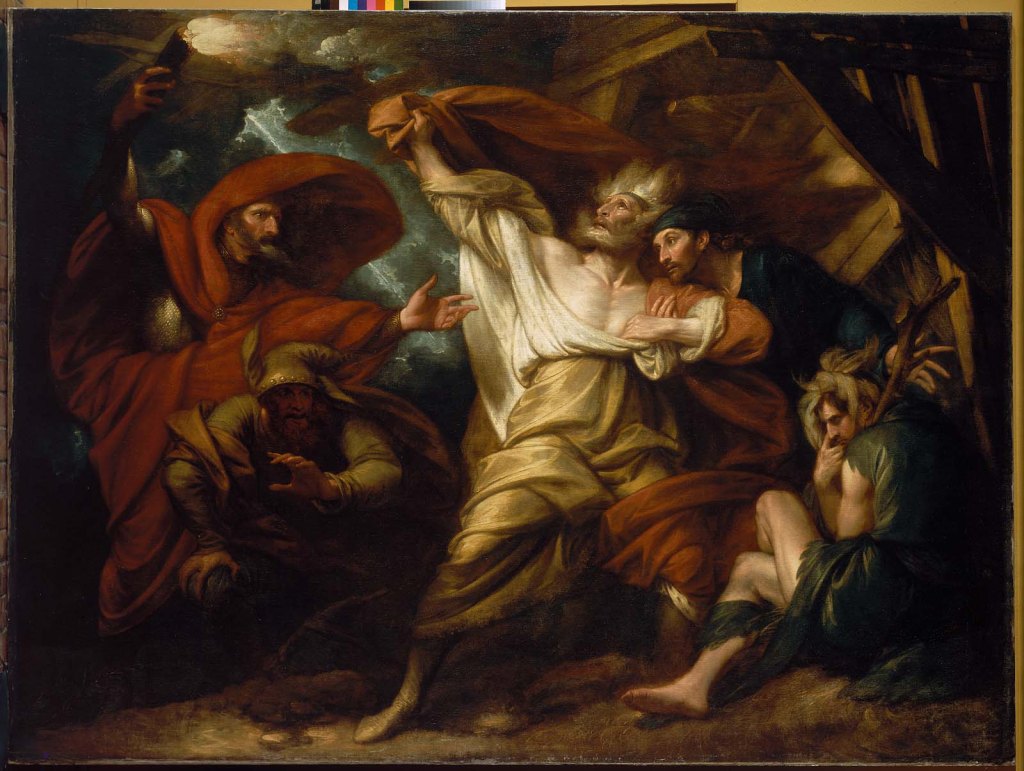
The Tragedy of King Lear may very well be Shakespeare’s crowning achievement, and possibly the best play written in literary history. Personally, I am divided between King Lear and Hamlet, though in periods Othello and Macbeth will make their appearance, in periods Anthony and Cleopatra or Measure for Measure. Even The Tempest, Twelfth Night or Henry IV Part 1, Henry IV Part 2 and The Merry Wives of Windsor (the latter three) in which Falstaff appears will at times cast their vote, and with serious legitimacy.
However, I always return — willingly or unwillingly I do not know — to King Lear and Hamlet, and upon yet another re-reading I find myself forced to recognize these two plays as the greatest Shakespearean triumphs, even within the Shakespearean cosmos these two plays stands out with such originality, imaginative inventiveness, and profound literary quality that they are essentially unrivaled and unsurpassed, not just within literature and poetry, but effectively within any production of human thought.
Racine never quite touched comedy (let us disregard Les Pleideurs), however he wrote tragedies — Phèdreis especially — that can somewhat rival that of Othello and Macbeth. Molière dared not write tragedies, but he wrote The Misanthrope and The Imaginary Invalid, two comedic classics that can rival any of Shakespeare’s pure comedies. However, where Racine triumphed in tragedy and Molière in comedy, Shakespeare managed to synthesise both tragedy and comedy with a disposition of such extraordinary genius that Racine, Molière, Goethe and Ibsen, four of our greatest playwrights, could never reach. In a sense King Lear and Hamlet embodies two perfect achievements.
In this issue I have embarked on a rather comprehensive commentary of scene 1.1 of King Lear. Every passage has been dissected, but with an eye on keeping the meaning as succinct as possible so as not to overwhelm the reader. Hopefully this will encourage the curious reader, and the reader of classic literature and The Western Canon as a whole, to embark on their own journey into the work(s) of Shakespeare, who after all is the monolith at the centre of our canon.
This issue does not seek to politicise King Lear, nor does it attempt to prescribe it any ideologies. I will leave this to the new-historicists, cultural-materialists, feminists and various psychoanalytic approaches, all of which I rather detest, and equally find little if any literary value in (see my defence of the canon). On the contrary, this commentary seeks to help the reader understand the text, in order to appreciate the aesthetic supremacy of King Lear and its endless imaginative originality.
Nowhere in literature do we find characters such as the characters on display in The Tragedy of King Lear. Starting with King Lear himself: the doomed, tragic and mad king whose self-perception, cognitive stability and psychological gestalt slowly and forcefully changes over the course of the play. He is in many aspects the Shakespearean answer to Job; who is equally doomed, equally tragic. But where Job is more of a static entity, Lear changes, he develops, his self-perception and madness drives forward relentlessly. While Lear never fully recovers his sanity (has he ever actually been sane is a question raised by Gonerill and Regan in scene 1), his values certainly changes. Hence the force involved. But more interestingly: while we as reader’s feel the slow and gradual change of Lear, we as reader’s are changing too. This is Shakespeare’s true legacy; beyond his magnificent poetry and linguistic capabilities (we see many poets who can rival his lyricism: Milton, Wordsworth, Whitman, to name a few), it is, to quote Harold Bloom: “The peculiar magnificence of Shakespeare in his power of representation of human character and personality and their mutabilities (…)” (The Western Canon: 1994).
We can all recognize ourselves in Shakespeare’s cast of characters, because we are all his characters, just as we are not them.
Lear is but one character in this magnificent play. I would be remiss not to mention the bastard Edmund who is an intelligent, clever, cynical and nihilistic engine at the very heart of the play. A villain rivalling Othello’s Iago, but as Harold Bloom points out, even “out-Iagoing Iago.” Where Lear is a narcissist who arguably cares too much, Edmund is a narcissist who cares not at all.
And who can love Edmund but Lear’s self-absorbed daughter’s Gonerill and Regan? Lest we forget the truthful Cordelia, the eccentric enigma that is The Fool, faithful Kent, heroic Edgar/poor Tom, old Gloucester, among many other spectacular characters.
In King Lear, every character is important, every character is autonomous. Arguably, the loss of one character would mean the loss of the play as a whole.
To the avid Shakespeare reader (and re-reader) the characters will present themselves within the life of the reader. Lear will represent the part of our psychology and nature which is truly Lear, or Hamlet, Othello, Falstaff, The Fool, Edmund, etc. Bloom points this out rather elegantly: “If you are a moralist, Falstaff outrages you; if you are rancid, Rosalind exposes you; if you are dogmatic, Hamlet evades you forever. And if you are an explainer, the great Shakespearean villains will cause you to despair. Iago, Edmund, and Macbeth are not motiveless; they overflow with motives, most of which they invent or imagine for themselves. Like the great wits— Falstaff, Rosalind, Hamlet— these monstrous malevolences are artists of the self, or free artists of themselves (…)” (The Western Canon: 1994).
But the characters are not merely us, they are also tools with which we can judge ourselves, see ourselves as it is ‘from the outside.’ While Miguel de Cervantes taught us how to talk to one another in Don Quixote (with dialogue as a means to self-realization); Shakespeare taught us how to talk to ourselves. But Shakespeare gave us more, in fact, the characters in his plays functions not merely as ways in which we can judge and talk to ourselves, they are equally to be seen as external modalities that are judging us — whether we want to be judged or not. This is an important and crucial difference Bloom points out between, say Dante’s Divine Comedy in which we find utter strangeness: “Dante interprets his characters for you; if you cannot accept his judgments, his poem abandon you” contrary to “Shakespearean drama” which “seems at once utterly familiar and yet too rich to absorb all at once.” (The Western Canon: 1994).
Without further ado I will finish this short(er) introduction — as this issue itself is long enough — with another quote from prof. Harold Bloom who is my dear, literary friend, even in death (call him my inner Falstaff), and the critic who will stand as one of the greatest minds in Western literary history:
“I feel quite alone these days in defending the autonomy of the aesthetic, but its best defense is the experience of reading King Lear and then seeing the play well performed. King Lear does not derive from a crisis in philosophy, nor can its power be explained away as a mystification somehow promoted by bourgeois institutions. It is a mark of the degeneracy of literary study that one is considered an eccentric for holding that the literary is not dependent upon the philosophical, and that the aesthetic is irreducible to ideology or to metaphysics. Aesthetic criticism returns us to the autonomy of imaginative literature and the sovereignty of the solitary soul, the reader not as a person in society but as the deep self, our ultimate inwardness. That depth of inwardness in a strong writer constitutes the strength that wards off the massive weight of past achievement, lest every originality be crushed before it becomes manifest.” (The Western Canon: 1994)
Finally, this issue is making use of Penguin Classics: ‘King Lear’ (1972) and the revised text (1996). For further recourses, see Harold Bloom, T.J.B. Spencer, Stanley Wells, George Hunter, Kiernan Ryan, Frank Kermode, among many other great Shakespearean scholars.
King Lear, scene 1.1: Full commentary.
– Characters involved:
King Lear
Gonerill
Regan
Cordelia
Duke of Albany
Duke of Cornwall
King of France
Duke of Burgundy
Earl of Kent
Earl of Gloucester
Edmund the bastard
Scene 1.1
Kent: I thought the King had more affected the Duke of Albany than Cornwall.
- This is the first mention of King Lear. Kent is Lear’s loyal and ever-faithful servant. In this opening line he proposes how he had always thought Lear to have more affection for the Duke of Albany rather than the Duke of Cornwall. This will prove an important observation as we approach especially the latter part of the play in which Albany and Cornwall’s nature respectively will reveal itself.
Gloucester: It did always seem so to us. But now in the division of the kingdom it appears not which of the Dukes he values most, for qualities are so weighed that curiosity in neither can make choice of either’s moiety.
- Gloucester confirms that this has always been the consensus. However, after the “division of the kingdom” meaning Lear’s decision to divide his kingdom into three parts, one for each of his three daughters (effectively splitting up Britain), it is no longer clear who Lear is preferring more. Favouritism seems to have become murky, obscure, as has Lear’s decision-making and sanity.
– Moiety = share (their share of the kingdom).
Kent: Is not this your son, my lord?
- Kent is pointing to Edmund the Bastard, asking Gloucester if he is not his (Gloucester’s) son.
– It is not a coincidence that the chief villain in the play Edmund the Bastard, the nihilist who in essence cares about nothing, is being mentioned so early after we have been introduced to King Lear, who arguably cares too much about everything. The play is riddled with these subtextual mirrorings.
Gloucester: His breeding, sir, hath been at my charge. I have so often blushed to acknowledge him that now I am brazed to it.
- By “breeding” Gloucester is referring to his responsibility for Edmund’s upbringing: financially, his education, etc. He is stating that he has so often been ashamed to acknowledge Edmund that now he can do so without blushing. Brazed as in something that has been hardened, i.e: there is a loss of shame and embarrassment in acknowledging Edmund.
Kent: I cannot conceive you.
- Ken does not understand Gloucester’s point (he is not aware of the bastardy).
Gloucester: Sir, this young fellow’s mother could; whereupon she grew round-wombed, and had indeed, sir, a son for her cradle ere she had a husband for her bed. Do you smell a fault?
- Gloucester points to the fault (the sin) of the situation; meaning Edmund’s mother was not married, i.e: she had a man (Gloucester himself) in her bed before she had taken a husband.
Kent: I cannot wish the fault undone, the issue of it being so proper.
- Kent proclaims he would not want the “fault” as in Edmund, being a bastard, “undone” as he has turned out “so proper”/so good. Proper here refers to handsome as well, and one can easily see Kent’s remark as a somewhat hidden irony. As if Edmund is almost too proper, to a fault (this is also pointed out by prof. George Hunter in his commentary).
Gloucester: But I have a son, sir, a son by order of law, some year elder than this, who yet is no dearer in my account. Though this knave came something saucily to the world, before he was sent for, yet his mother fair; there was good sport at his making, and the whoreson must be acknowledged. Do you know this noble gentleman, Edmund?
- Gloucester is referring to his other, legitimate son, Edgar. He loves both sons in equal amounts, despite the “knave”/boy Edmund being a bastard and illegitimate. Notice, (I) the use of the rather fantastic adjective “saucily”, and (II) how Gloucester quite comedically remarks there was “good sport” making Edmund; as in his mother “was fair”/beautiful, and they had a good time making him. It is the first of many tragi-ironic moments in this play.
— Then Gloucester points to Kent and asks Edmund if he knows him.
Edmund: No, my lord.
- Edmund is not familiar with Kent.
Gloucester: My lord of Kent. Remember him hereafter as my honourable friend.
- Gloucester introduces Kent as his “honourable”/good friend.
Edmund: My services to your lordship.
- Edmund’s at Kent’s service.
Kent: I must love you and sue to know you better.
- Kent is expressing how he “sue”/begs/ is looking forward to getting to know Edmund. One can sense again in Kent an undertone of irony that is so important and prevalent in the Shakespearean cosm.
Edmund: Sir, I shall study deserving.
- Edmund will make a great effort to deserve or earn Kent’s esteem.
Gloucester: He hath been out nine years, and away he shall again. The King is coming.
- Gloucester refers to Edmund having been out of the country for nine years, and will soon depart again. Hence Kent being unfamiliar with the existence of Edmund.
(King Lear enters with the Dukes, and his three daughters: Regan, Goneril and Cordelia. As well as attendants)
Lear: Attend the lords of France and Burgundy, Gloucester.
- Lear asks of Gloucester to attend to the rulers of France and Burgundy.
Gloucester: I shall, my liege.
- Gloucester complies (leaves with Edmund).
Lear: Meantime we shall express our darker purpose.
Give me the map there. Know, that we have divided
In three our kingdom; and ‘tis our fast intent,
To shake all cares and business from our age,
Conferring them on younger strengths, while we
Unburdened crawl toward death. Our son of Cornwall –
And you, our no less loving son of Albany –
We have this hour a constant will to publish
Our daughters’ several dowers, that future strife
May be prevented now. The princes, France and Burgundy,
Great rivals in our youngest daughter’s love,
Long in our court have made their amorous sojourn,
And here are to be answered. Tell me, my daughters,
Since now we will divest us both of rule,
Interest of territory, cares of state,
Which of you shall we say doth love us most,
That we our largest bounty may extend
Where nature doth with merit challenge. Gonerill,
Our oldest born, speak first.
- This is Lear’s first appearance. He is telling his surroundings of his darker purpose which is his secretive plan of diving the kingdom into three parts. One for each of his daughter’s: Gonerill, Regan and Cordelia, so that he may “unburdened crawl toward death.” It is a statement that is as contradictory as Lear himself. “Unburdened” and “crawl” are two different modes of being; crawling is by definition a burden. Prof. Hunter notes that this is a sign of the abdication of Lear’s kingdom essentially being a charade rather than a necessity.
– We further see in line 2-3: “fast intent” and “shake“, once again two seemingly opposite modalities. While the abdication certainly is a charade; the way in which Lear has been portrayed early in the play is intentional and important. It is an obvious sign that King Lear is a man of a contradictory, wild and possibly unstable nature.
– As for the abdication of his kingdom: One of the three parts is larger and more bountiful than the rest. Lear is asking of his daughter’s to proclaim their love for him, so that the daughter who loves him the most can have the best piece of land: “That we our largest bounty may extend.”
– The psychological ramification(s) of Lear’s request is palpable, fascinating and deeply disturbing. This is an early and clear indication of Lear’s rash nature and unpredictable decision-making, as well as his self-perception as a sort of omnipotent entity, God-like, who can get away with a request of such cruel and primitive nature by way of his status as a king.
Gonerill: Sir, I love you more than word can wield the matter,
Dearer than eyesight, space, and liberty,
Beyond what can be valued rich or rare,
No less than life, with grace, health, beauty, honour,
As much as child e’er loved or father found;
A love that makes breath poor and speech unable;
Beyond all manner of ‘so much’ I love you.
- Gonerill is proclaiming her love to Lear in words of absolute extravagance. Her “love” such love as it is goes beyond the weight of words and of liberty, and beyond all manner of “so much“, meaning all the ways in which she can tell Lear how much she loves him.
Cordelia (aside): What shall Cordelia speak? Love, and be silent.
- Lear’s youngest daughter Cordelia is nervously standing on the sideline, not knowing how to handle this redundancy of extravagant appraisal. Gonerill has now verbalised her love, and Cordelia has nothing left but to be silent. It is not in Cordelia’s nature to be loquacious, rather she is a taciturn, quiet, introverted person.
Lear: Of all these bounds, even from this line to this,
With shadowy forests and with champains riched,
With plenteous rivers and wide-skirted meads,
We make thee lady. To thine and Albany’s issues
Be this perpetual. – What says our second daughter,
Our dearest Regan, wife of Cornwall?
- Lear is satisfied with Gonerill’s proclamation of her love and he grants her one slice of the kingdom. This will now belong to her and Albany’s future descendants, meaning Britain will be split, and no longer stand as a United Kingdom.
– Notice the beautiful imagery of nature in this passage; something that has obviously inspired later poets such as Keats and Whitman, lest one forget William Wordsworth, as is noted by Prof. Alwin Thaler: “[Wordsworth’s poetry] abounds in reminiscence of Shakespearian scene and phrasing.“
Regan: I am made of that self mettle as my sister
And price me at her worth. In my true heart
I find she names my very deed of love;
Only she comes too short, that I profess
Myself an enemy to all other joys
Which the most precious square of sense possesses,
And find I am alone felicitate
In your dear highness’ love.
- Regan goes further than Gonerill in the sense that she proclaims to abandon “all other joys” as her love for her father is the most important factor. In fact: what truly constitutes her happiness is her father’s love. Felicitate = joyful. Even the joys: “which the most precious square of sense possesses” she is an enemy to, as these joys do not by necessity lead to her father’s joy/love.
– Regan, like Gonerill, is pouring an extravagance of words which is — quite obviously, yet not so obvious as one would think — telling of their secret motives.
Cordelia (aside): Then poor Cordelia!
And yet not so, since I am sure my love’s
More ponderous than my tongue.
- Cordelia feels subdued and defeated in light of her sister’s excessive verbal appraisal of Lear. She does not feel that she can compete with them, however “and yet not so” as she knows of her love within, and that it is stronger, more real than the empty words spewed.
Lear: To thee and thine hereditary ever
Remain this ample third of our fair kingdom,
No less in space, validity, and pleasure
Than that conferred on Gonerill. – Now, our joy,
Although our last and least, to whose young love
The vines of France and milk of Burgundy
Strive to be interessed: what can you say to draw
A third more opulent than your sisters’? Speak!
- Regan gets her share of the land and it shall belong to her and Cornwall, and their descendants. Britain is now split up in two equal parts: “no less in space, validity, and pleasure.” In the end it is Cordelia’s turn, Lear’s youngest and favourite daughter: “our joy“, to declare her love.
– The word “Least” is here not meant as in the least loved, but rather as the youngest (least: literally youngest/smallest) daughter. Whether this is a Shakespearean wordplay or simply Elizabethan language is difficult to say, both have been pointed out by scholars.
– The King of France and the Duke of Burgundy are present as one of them will marry Cordelia.
Cordelia: Nothing, my lord.
- Cordelia has nothing to say. She refuses to partake in this farce.
Lear: Nothing?
- One can almost feel Lear’s stab of horror.
Cordelia: Nothing.
- Cordelia is unyielding.
Lear: Nothing will come of nothing. Speak again.
- Lear is baffled, shocked, that his youngest daughter refuses to appraise him. This is Lear’s first of a series of existential collisions that are pushing his values, his self-image and his self-ideation closer to the metaphorical ‘edge’.
Cordelia: Unhappy that I am, I cannot heave
My heart into my mouth. I love your majesty
According to my bond, no more nor less.
- Cordelia confesses that she loves Lear according to her bond, meaning the affection that is naturally there between a child and a parent. No more, nor less. Meaning a lot, yet with the duties this relationships brings with it. In other words: it is pure, respectful and natural.
– She refuses to “heave” her “heart into” her mouth; actions are for Cordelia the truth, not the spoken word (which is fleeting, noncommittal and does not hold one accountable).
Lear: How, how, Cordelia! Mend your speech a little
Lest you may mar your fortunes.
- Lear is shocked. He threatens Cordelia that she may lose the fortunes that can be hers, i.e. the third piece of the kingdom as well as a favourable marriage with either the King of France or the Duke of Burgundy.
Cordelia: Good my lord,
You have begot me, bred me, loved me.
I return those duties back as are right fit,
Obey you, love you, and most honour you.
Why have my sisters husbands, if they say
They love you all? Haply when I shall wed,
That lord whose hand must take my plight shall carry
Half my love with him, half my care and duty.
Sure I shall never marry like my sisters,
To love my father all.
- Cordelia proclaims she is willing to give everything back to her father as he has given her; once again: “no more nor less.” It is according to their bond. She questions here her sister’s motives. How can they proclaim to fully love Lear when they are both married? She is further pushing Lear’s self-image and self-perception by stating once she is married, her husband will carry half her love, hence she cannot love Lear with all of her heart. She raises this obvious contradiction, yet it goes unanswered by Lear (as he is delusional) and her sisters (as they have their own cunning motives).
– To reiterate: The contradiction will prove important. Either the sisters fully love Lear meaning they cannot love their husbands, or they do in fact not love Lear as they proclaim, and they have other motives. Cordelia is essentially calling her sisters out on their schemes.
Lear: But goes thy heart with this?
- Lear is asking if she truly stands by her sentiment.
– He is not hearing what she is saying, rather he is solely feeling the attack on his own worth, his own self.
Cordelia: Ay, my good lord.
- Cordelia stands her ground.
Lear: So young, and so untender?
- So young and so “untender“/rigid, with such a ‘lack’ of emotion for her own father.
Cordelia: So young, my lord, and true.
- Cordelia proclaims it may be harsh (another clash with Lear’s self-perception) yet, she is speaking the truth.
– Cordelia embodies truth and honesty, contrary to her sisters.
Lear: Let it be so! Thy truth then be thy dower!
For by the sacred radiance of the sun,
The mysteries of Hecat and the night,
By all the operation of the orbs
From whom we do exist, and cease to be,
Here I disclaim all my paternal care,
Propinquity and property of blood,
And as a stranger to my heart and me
Hold thee from this for ever. The barbarous Scythian,
Or he that makes his generation messes
To gorge his appetite, shall to my bosom
Be as well neighboured, pitied, and relieved
As thou my sometime daughter.
- Lear proclaims her truth (such truth as he considers it) shall be her inheritance. Meaning she will inherit as much as he considers her love for him, that is to say (to reference 88-90): nothing.
– He then follows this up by telling her that he will “disclaim all my paternal care, Propinquity and property of blood, And as a stranger to my heart and me, Hold thee from the for ever.” Lear no longer considers Cordelia his own child. He is not merely disinheriting her as it pertains to land, but also as her father, and of being related by blood. He swears this by “the sacred radiance of the sun” that is to say the sun’s holy light, and on the mysteries of Hecat, the greek goddess often associated with the moon and witchcraft, meaning darkness and night. It is a play on light and darkness. Lear swears on both so as to fully disinherit Cordelia. It is an obvious punishment to fit the crime of Cordelia’s statement of never being able to fully love Lear if she were to marry. Lear retaliates harshly and bluntly; as he swears by both light and darkness, meaning whereas she can never fully love him, he can on the contrary fully and utterly, disinherit her.
– In the final three lines Lear tells Cordelia that even the barbarians who are eating their own kin are as “well neighboured, pitied and relieved” as she is.
– She is now Lear’s (and what a magnificent way of phrasing it): “sometime daughter.” His former daughter.
Kent: Good my liege —
- Kent tries to intervene, as he is recognizing Cordelia’s honesty.
Lear: Peace, Kent!
Come not between the dragon and his wrath.
I loved her most, and thought to set my rest
On her kind nursery. (To Cordelia) Hence and avoid
my sight! —
So be my grave my peace as here I give
Her father’s heart from her. Call France! Who stirs?
Call Burgundy! Cornwall and Albany,
With my two daughers’ dowers digest the third.
Let pride, which she calls plainness, marry her.
I do invest you jointly with my power,
Pre-eminence, and all the large effects
That troop with majesty. Ourself by monthly course,
With reservation of an hundred knights,
By you to be sustained, shall our abode
Make with you by due turn. Only we shall retain
The name and all th’addition to a king; the sway,
Revenue, execution of the rest,
Beloved sons, be yours; which to confirm,
This coronet part between you.
- Lear proclaims how he loved Cordelia the most, and that he was hoping to settle and grow old in her care. He then tells Cordelia to leave: “Hence and avoid my sight!“; but as he but a moment later calls for France and Burgundy, it is assumed she disobeys and stays. Lear tells his two older daughters that they will “digest the third,” i.e: Cordelia’s part of the kingdom.
– He then mocks what Cordelia calls truth as being mere pride (how ironic considering Lear’s own distorted pride): “Let pride, which she calls plainness, marry her.”
– He proceeds to proclaim he will take a hundred knights, and stay one month at each daughter’s place. He will retain the name and title of a king: “Only we shall retain the name and all th’addition to a king“; although the power, income and responsibility of the kingdom(s) (as it has now been split up) will befall his sons-in-law Albany and Cornwall.
– Notice especially the momentum and excessive rambling of Lear’s proclamations. It is both fascinating and terrifying the way in which Lear’s monologues are swaying from one extremity to the other both emotionally, semantically and by way of his actions. The madness on display is exceptional.
Kent: Royal Lear,
Whom I have ever honoured as my king,
Loved as my father, as my master followed,
As my great patron thought on in my prayers —
- Kent knows his master King Lear and his psychological deficiencies (possibly he has noticed the mental decline long before this scene, as has Gonerill and Regan as we shall later see), and he is recognizing the doom of Lear’s actions.
Lear: The bow is bent and drawn; make from the shaft.
- Some critics have sensed a double-meaning here. Lear essentially tells Kent to hurry up and come to the conclusion as the bow is bent and drawn. It has by some been interpreted as a direct threat: if he does not hold his tongue he will suffer from the arrow that is about to be shot. This, however seems to contradict the fact that Kent subsequently is allowed a long(er) monologue. Here prof. Hunter’s explanatory note: “(…) now let the point (barbed, no doubt) fly forward like an arrow” seems more likely to fit Lear’s words.
Kent: Let it fall rather, though the fork invade
The region of my heart. Be Kent unmannerly
When Lear is mad. What wouldst thou do, old man?
Think’st thou that duty shall have dread to speak
When power to flattery bows? To plainness honour’s
bound
When majesty stoops to folly. Reserve thy state,
And in thy best consideration check
This hideous rashness. Answer my life my judgement,
Thy youngest daughter does not love thee least,
Nor are those empty-hearted whose low sounds
Reverb no hollowness.
- Once again, there is the interpretation that Kent is disregarding the direct threat as he cares more for the King to know the truth than he cares for his own life. However, I am inclined to lean on prof. Hunter who interprets Kent’s words as: “I should prefer that my argumentative point [Kent’s] should not hit you, even if the mis-shot arrow should kill me instead.” It is a semantic point rather than a physical threat from Lear.
– “Be Kent unmannerly, When Lear is mad. What wouldst thou do, old man?” this is an extraordinary and almost uncanny way in which Kent is addressing his beloved king. Kent excuses his mannerisms, however he must be direct as he recognises the immediate danger Lear is putting himself in (and his kingdom) by his impulsive actions. Kent is of the opinion that if he considers himself bound to honour/an honourable man, then he must speak to the king’s “hideous rashness.”
– He recommends the king to “reserve thy state” meaning Lear must keep his position so that the kingdom can stay intact. There are some interpretations that postulates, though rather exotically, that Kent is pleading for Lear to keep his “state” as in his mental state intact.
– Finally Kent recognises Cordelia’s love is real, despite it not being reduced to the meaningless flattery of “empty words whose low sounds reverb no hollowness“.
Lear: Kent, on thy life, no more!
- Lear is outraged. His self-image and self-perception is being threatened not only by his daughter, but now by his ever faithful servant as well.
Kent: My life I never held but as a pawn
To wage against thine enemies; nor fear to lose it,
Thy safety being the motive.
- Kent proclaims his life is Lear’s to do with anyway: “My life I never held but as a pawn” and that he has no fear of losing it as he serves Lear loyally and unconditionally. He is only here to “wage against” Lear’s “enemies.” That is his sole purpose in life. (This will be very important later in the play).
Lear: Out of my sight!
- Lear is outraged, and for the second time (think of Cordelia) his direct order is disobeyed.
Kent: See better, Lear, and let me still remain
The true blank of thine eye.
- Kent twists Lear’s words “Out of my sight!” and tells Lear to “see better“, and to let him (Kent) remain the aim for his (Lear’s) eyes, or to be in the bull’s-eye so to speak. In essence Kent tells Lear that the truth is right in front of him in Kent and Cordelia.
Lear: Now by Apollo —
- There are several reasons why Apollo has been chosen, I will here lean on prof. Hunter’s explanation: “An appropriate god to invoke at this point, as he was both the archer god (the god of straight aiming at targets) and the sun god (the god of clear seeing).“
Kent: Now by Apollo, King,
Thou swear’st thy gods in vain.
- Kent is telling Lear defiantly that he (Lear) is taking the gods name’s in vain. He is continually contradicting his master in order for him to see the truth of his folly. It is a kind of mild shock-therapy though it turns out to be (at this point) unsuccessful.
Lear: O vassal, miscreant!
(Lear makes to strike Kent)
- “Miscreant” can have several meanings; at first glance Lear is merely calling him a law-breaker or a rule-breaker, one could even translate it to a villain. But as it has been stated in Ox.Dict: “Middle English (as an adjective in the sense ‘disbelieving’): from Old French mescreant, present participle of mescreire ‘disbelieve’, from mes- ‘mis-’ + creire ‘believe’ (from Latin credere).” The word is more than likely chosen as Lear is calling Kent a disbeliever (for referring to the Gods) as well as a villain.
Albany and Cornwall: Dear sir, forbear!
- Albany and Cornwall are intervening and preventing Lear from hitting Kent.
Kent: Kill thy physician and thy fee bestow
Upon the foul disease. Revoke thy gift;
Or whilst I can vent clamour from my throat
I’ll tell thee thou dost evil.
- Kent tells Lear that removing him (and those he should trust) is like removing the doctor, meaning there is no one left to cure the disease. “Revoke thy gift”; Kent is pleading for Lear to take back his actions, and if Lear refuses, Kent will: “whilst I can vent clamour from my throat” that is to say: as long as Kent still has the ability to speak, he will tell Lear that: “thou dost evil.” Meaning Lear’s actions are wrongful and detrimental to himself and the kingdom.
– It is a fantastic dramatic moment between Lear (the king) and Kent (the devoted servant), and the first slow shattering of King Lear’s egotistical self.
Lear: Hear me, recreant!
On thine allegiance, hear me!
That thou hast sought to make us break our vow,
Which we durst never yet, and, with strained pride,
To come betwixt our sentence and our power,
Which nor our nature nor our place can bear,
Our potency made good, take thy reward.
Five days we do allot thee for provision
To shield thee from diseases of the world,
And on the sixth to turn thy hated back
Upon our kingdom. If on the tenth day following
Thy banished trunk be found in our dominions,
The moment is thy death. Away! By Jupiter,
This shall not be revoked.
- Lear is bursting with anger, calling Kent a “recreant” meaning a coward, traitor or in the translation of Niels Brunse: “a false dog.” Lear is accusing Kent of trying to “break our [Lear’s] vow” which is what Cornwall and Albany have been promised.
– He is further accusing Kent of coming between Lear’s “sentence and our [Lear’s] power,” which Lear cannot accept by “nature” (that is to say Lear’s own nature: egomaniac and narcissistic — as pointed out by Schafer, 2010). Nor can his royal “place” bear it. Therefore, since Kent has interceded, he is now to be given his reward (sarcastically, of course): “take thy reward.”
– Lear tells Kent he will be granted five days of provision and on the sixth day he must have left the kingdom. If he has not, if his “banished trunk” meaning his body, is still to be found inside the land, he will be sentenced to death.
– Lear’s final remark: “This shall not be revoked” is obviously an ironic and sarcastic remark, contrasting Kent’s earlier plead to Lear, urging him to “reserve thy state.” It means: Lear will not change (at least for now).
Kent: Fare thee well, king: sith thus thou wilt appear
Freedom lives hence and banishment is here.
To CORDELIA
The gods to their dear shelter take thee, maid,
That justly think’st, and hast most rightly said.
To REGAN and GONERILL
And your large speeches may your deeds approve,
That good effects may spring from words of love.
Thus Kent, O princes, bids you all adieu;
He’ll shape his old course in a country new.
(Kent leaves)
- Kent takes his leave. As a final remark he tells the king that freedom is now gone, only banishment is left: “Sith thus thou wilt appear, Freedom lives hence and banishment is here.” Meaning not just Kent’s own fate, but the entire kingdom’s. “Sith thus thou wilt appear” would quite literally translate to ‘since this is how you choose to act.’
– Take note of Shakespeare’s beautiful rhymes.
– Kent then addresses Cordelia and asks of the gods to take her to “their dear shelter“/to protect her, and he proclaims she is telling the truth: “hast most rightly said.”
– To Regan and Gonerill he says: “And your large speeches may your deeds approve“/may their actions confirm their words of extravagance, so that “good effects may spring from words of love.” Prof. Hunter rightfully points out the distinction between “deeds” and “words”. Kent’s remarks are reeking with sarcasm.
– Kent then exits, saying “He’ll shape his old course in a country new.” Whether Kent is already aware of his future mission of disguising himself, and that his “old course” will be in a new country, as in an actual new country, or in the “new Britain” as it has now been split up, is not to say. One can assume Kent is talking about the ‘new country’ (literally Britain being split), as well as the apocalyptic psychological landscape Lear has created from his mad and rash decisions.
Flourish. Re-enter GLOUCESTER, with KING OF FRANCE, BURGUNDY, and Attendants
Gloucester: Here’s France and Burgundy, my noble lord.
- Burgundy and France enters.
Lear: My lord of Burgundy.
We first address towards you, who with this king
Hath rivall’d for our daughter: what, in the least,
Will you require in present dower with her,
Or cease your quest of love?
- Lear is asking Burgundy, who is rivalling the King of France for Cordelia’s hand, what would be the least he would be willing to accept as inheritance; before he gives up his “quest of love.” Lear is asking this as Cordelia has lost the right to the third part of the kingdom.
Burgundy: Most royal majesty,
I crave no more than hath your highness offer’d,
Nor will you tender less.
- Burgundy will settle for no more or no less than what Lear has already offered. That is to say, he is exclusively interested in the land and the inheritance, not in Cordelia.
Lear: Right noble Burgundy,
When she was dear to us, we did hold her so;
But now her price is fall’n. Sir, there she stands:
If aught within that little seeming substance,
Or all of it, with our displeasure pieced,
And nothing more, may fitly like your grace,
She’s there, and she is yours.
- Lear tells Burgundy that Cordelia’s price is no longer the same as she has fallen from grace. “If aught within that little seeming substance, Or all of it, with our displeasure pieced, And nothing more, may fitly like your grace, She’s there, and she is yours.” While prof. Hunter argues that the first part “little-seeming substance” means something equivalent to, “that girl so devoted to substance and fact, so little concerned with seeming,” I personally find, considering Lear’s later nasty and spiteful comments, this to mean a direct attack on Cordelia as being nothing but a “little seeming substance,” i.e. a worthless being.
– What Lear is then telling Burgundy is if he can do with Cordelia alone, and nothing else (no inheritance of any kind), then “she’s there, and she is yours.“
Burgundy: I know no answer.
- Burgundy will not answer as it is the inheritance he is after. Not love.
Lear: Will you, with those infirmities she owes,
Unfriended, new-adopted to our hate,
Dower’d with our curse, and stranger’d with our oath,
Take her, or leave her?
- Lear’s words are harsh and radical. He enumerates his contempt for his daughter, asking Burgundy if he wishes to take Cordelia now as she is “Unfriended, new-adopted to our hate, Dower’d with our curse, and stranger’d with our oath.” Lear’s question is an obvious bait as he does not wish Burgundy to take Cordelia to wife as this would be another crack in his self-image. How could anyone, in Lear’s mind, want someone as cruel and pitiless as Cordelia?
– Taking Cordelia would be tantamount to accepting her words (or lack thereof) as true. Something a narcissist like Lear who cares too much could never handle. This is contrary to Edmund, who is equally a narcissist, though of a nihilistic disposition.
Burgundy: Pardon me, royal sir;
Election makes not up on such conditions.
- Burgundy cannot settle on a choice, especially considering the conditions and the situation Lear has put forth.
Lear: Then leave her, sir; for, by the power that made me,
I tell you all her wealth.
(To king of France)
For you, great king,
I would not from your love make such a stray,
To match you where I hate; therefore beseech you
To avert your liking a more worthier way
Than on a wretch whom nature is ashamed.
Almost to acknowledge hers.
- Lear tells Burgundy to leave her (one can imagine Lear’s satisfaction) as what he has described “by the power that made me, I tell you all her wealth” is Cordelia’s actual wealth, i.e: all she is worth is nothing.
– He then speaks directly to the King of France, proclaiming that he would never stray so far/”make such a stray” as to match the King with something he (Lear) hates, and he therefore “beseech(es)” the King to turn his attention, his love, in the direction of someone who deserves it: “worthier way“; rather than a “wretch whom nature is ashamed.” Lear’s verbal assault on his daughter is fierce.
– Once again, Lear is phrasing this in a way in which neither the Duke of Burgundy nor the King of France should want to take Cordelia. It is crucial for Lear’s self-perception and narcissism that Cordelia be left alone. It can only hurt him if she’s taken.
France: This is most strange,
That she, that even but now was your best object,
The argument of your praise, balm of your age,
Most best, most dearest, should in this trice of time
Commit a thing so monstrous, to dismantle
So many folds of favour. Sure, her offence
Must be of such unnatural degree,
That monsters it, or your fore-vouch’d affection
Fall’n into taint: which to believe of her,
Must be a faith that reason without miracle
Could never plant in me.
- The King of France is questioning how Cordelia, who up until now has been Lear’s “best object” and “the argument of your praise” have committed a thing so “monstrous, to dismantle So many folds of favour.” France is skeptical, and he is metaphorically setting up one of the important themes in the play: “to dismantle so many folds of favour.” Prof. Hunter translates it to: “Strip away the protecting clothing of your favour.” The idea of ‘stripping clothes’ is immensely important later in the play; so is the concept of stripping away ones identity in order to survive and have a stake in the overall game/process (ex.: Ken and Edgar who disguises themselves). — Where Lear’s self-perception is cracking like a cheap mirror, scene after scene, other characters must change entirely in order to find back to themselves again. It is a crucial double-play.
– France further points out how if Cordelia’s monstrous treason is not of such “unnatural degree, That monsters it” then Lear’s “fore-vouch’d affection” will fall “into taint” meaning, become suspect, doubtful. France is challenging — knowingly or unknowingly — Lear’s self-image. It is an important confrontation.
– Finally France points out how faith is the only way in which one can believe that Cordelia has committed such a terrible crime. Reason alone cannot justify it, and since faith does not work through rational means, only by way of miracle, that leaves France confused.
Cordelia: I yet beseech your majesty,
If for I want that glib and oily art,
To speak and purpose not; since what I well intend,
I’ll do’t before I speak,–that you make known
It is no vicious blot, murder, or foulness,
No unchaste action, or dishonour’d step,
That hath deprived me of your grace and favour;
But even for want of that for which I am richer,
A still-soliciting eye, and such a tongue
As I am glad I have not, though not to have it
Hath lost me in your liking.
- Cordelia pleads with France, saying “If for I want that glib and oily art, To speak and purpose not“; meaning she may lack the art of flattery and of hollow words, she is instead one who acts before she speaks.
– Cordelia has not lost the king’s favour for a “vicious blot, murder, or foulness, No unchaste action, or dishonour’d step” rather she has lost the king’s favour for a lack of talent for empty words, and her sister’s “ogling for favours” (prof. Hunter).
– Cordelia is glad that she does not posses this cunning, however, not to have it “hath lost me in your [Lear’s] liking.” She stands her ground until the end, yet recognises this is also what has lost her the King’s favour, and a father.
Lear: Better thou
Hadst not been born than not to have pleased me better.
- This may be one of Lear’s most intimidating statements, and most telling as it pertains to his self-perception and self-image. He would rather have had that Cordelia had never been born, rather than not to have pleased him better. It is pure narcissism from someone who in every sense cares too much (contrary to Edmund as we shall later see).
France: Is it but this, a tardiness in nature
Which often leaves the history unspoke
That it intends to do? My lord of Burgundy,
What say you to the lady? Love’s not love
When it is mingled with regards that stand
Aloof from the entire point. Will you have her?
She is herself a dowry.
- France is astonished, and asks if the crisis is truly the case of Cordelia’s “tardiness” which “often leaves the history unspoke, That it intends to do?” Meaning Cordelia may not speak her innermost thoughts/”history unspoke“, however, she still acts.
– France then addresses Burgundy, telling him “Love’s not love When it is mingled with regards that stand Aloof from the entire point,” i.e. inheritance, power, wealth, is in the end not the point, rather love is. France continues: “she is herself a dowry“/an inheritance in-of-herself. It is quite a romantic ideal, and France is standing out in this scene (with Kent) as being intensely present and seeing through the wall of chaos.
– Personally, France gives me associations to Montaigne (see my previous blog post on Montaigne’s essays and Shakespeare).
Burgundy: Royal Lear,
Give but that portion which yourself proposed,
And here I take Cordelia by the hand,
Duchess of Burgundy.
- Burgundy now asks of Lear to give him the inheritance he had promised (the third part of the kingdom; meaning Burgundy himself would become a “king”) and he will happily take Cordelia’s hand and make her the “Duchess of Burgundy.“
Lear: Nothing: I have sworn; I am firm.
- Lear is as stubborn as a mule and refuse Cordelia any inheritance whatsoever.
Burgundy: I am sorry, then, you have so lost a father
That you must lose a husband.
- Burgundy is sorry for Cordelia’s loss, he points out she has not just lost a husband (that is to say Burgundy should they marry), she has also lost a father.
Cordelia: Peace be with Burgundy!
Since that respects of fortune are his love,
I shall not be his wife.
- Cordelia continues to stand her ground and be true to herself. “Since that respects of fortune are his love, I shall not be his wife.” Meaning: Since money and wealth is what Burgundy is after, she will not be his wife.
France: Fairest Cordelia, that art most rich, being poor;
Most choice, forsaken; and most loved, despised!
Thee and thy virtues here I seize upon:
Be it lawful I take up what’s cast away.
Gods, gods! ’tis strange that from their cold’st neglect
My love should kindle to inflamed respect.
Thy dowerless daughter, king, thrown to my chance,
Is queen of us, of ours, and our fair France:
Not all the dukes of waterish Burgundy
Can buy this unprized precious maid of me.
Bid them farewell, Cordelia, though unkind:
Thou losest here, a better where to find.
- France now proclaims his love. Contrary to Burgundy who is seeking wealth, France is falling in love with Cordelia for the lack of what she has. She has in other words become valuable and rich “being poor“, and as she has been abandoned she has become all the more precious. He declares to Lear that “thy dowerless daughter, king, thrown to my chance, is queen of us, of ours, and our fair France.” Cordelia is now the queen of France. And he (France) challenges the “waterish Burgundy” meaning “a weak, diluted man” (prof. Hunter) and his motives, telling him that no price could buy Cordelia back, his (France’s) “unprized precious maid.”
– He then asks of Cordelia to bid them all farewell as she may have lost a home here (in Britain), but in the process she has found a new home.
Lear: Thou hast her, France: let her be thine; for we
Have no such daughter, nor shall ever see
That face of hers again. Therefore be gone
Without our grace, our love, our benison.
Come, noble Burgundy.
- Lear’s final comment is that France can take her, little does it matter to him. Lear is not losing a daughter, as Cordelia is no longer his kin or blood. He will never want to “see that face of hers again“. He tells Cordelia to leave, and to do is without Lear’s grace, love and benison (benison = blessing).
Flourish. Exeunt all but KING OF FRANCE, GONERIL, REGAN, and CORDELIA
France: Bid farewell to your sisters.
- France asks of Cordelia to bid her sister’s farewell.
Cordelia: The jewels of our father, with wash’d eyes
Cordelia leaves you: I know you what you are;
And like a sister am most loath to call
Your faults as they are named. Use well our father:
To your professed bosoms I commit him
But yet, alas, stood I within his grace,
I would prefer him to a better place.
So, farewell to you both.
- Cordelia — most likely ironically — refers to her sister’s as “jewels of our father“; she will now depart them and leave them with tears in her eyes/”with wash’d eyes.” This has a double-meaning as these ‘tears’ are on the one hand actual tears from having lost her father, however, they are not real tears in the sense she will mourn having to depart from her sisters, rather her eyes are now washed, and she is able to clearly see her sisters for what they are.
– She further states she is “most loath to call Your faults as they are named” meaning she does not see it fit to criticise her sister’s and name their faults for what they truly are. The reason is possibly linked to Cordelia’s already taciturn and quiet nature; she will act (this we will see later) rather than speak.
– She will “commit” their father to the sister’s “professed bosoms“, meaning to the love and comfort they have claimed. Finally Cordelia wishes she “stood” “within his [Lear’s] grace” so that she could find better help for him.
– Cordelia is both self-analytical as well as analytical of the situation in which they all find themselves.
Regan: Prescribe not us our duties.
- Regan tell’s Cordelia not to presume to tell them their duties.
Gonerill: Let your study
Be to content your lord, who hath received you
At fortune’s alms. You have obedience scanted,
And well are worth the want that you have wanted.
- Both Gonerill and Regan are showing their ‘true colours’ — Gonerill is telling Cordelia she was received “At fortune’s alms.” Meaning only by the mercy and sympathy of the King of France. She tells Cordelia that she has “obedience scanted“, and she deserves to lose her father as she herself (Cordelia that is) has neglected him.
Cordelia: Time shall unfold what plaited cunning hides:
Who cover faults, at last shame them derides.
Well may you prosper!
- Time will truly unfold the sister’s intentions; their “cunning hides“; and how they crave nothing but power and wealth. This we shall later see through the nihilistic bastard Edmund (who unlike the sister’s and Lear is much more self-analytical and self-aware as it pertains to his own destructive role). In a sense they (the sister’s) are the embodiment of Lear. However where Lear will be forced to change and to re-evaluate himself, the sister’s will stay stuck as the stubborn incarnation of the Lear we see now (and never change), only to be lured into even deeper evil by Edmund.
France: Come, my fair Cordelia.
- –
Exeunt KING OF FRANCE and CORDELIA
Gonerill: Sister, it is not a little I have to say of what
most nearly appertains to us both. I think our
father will hence to-night.
- The sister’s are now alone and tête-à-tête. Gonerill proclaims she has a lot to say on the matter of what has happened, and she predicts their father will leave that very night, and stay as promised for a month with Gonerill.
Regan: That’s most certain, and with you; next month with us.
- Regan agrees.
Gonerill: You see how full of changes his age is; the
observation we have made of it hath not been
little: he always loved our sister most; and
with what poor judgment he hath now cast her off
appears too grossly.
- Gonerill’s statement is remarkable. The sister’s are highly calculated and their cunning have rested on their observation of their father’s madness and cognitive decline. Both have known Cordelia was the most loved: “he always loved our sister most“, but with the recent developments in Lear’s rash and unpredictable behaviour he has now cast away not just the daughter he loved the most, but also the daughter who loved him the most.
Regan: ‘Tis the infirmity of his age: yet he hath ever
but slenderly known himself.
- What Regan says is fascinating and profound. Lear, while with age he’s become more unstable and irascible, his nature has always been one of “slenderly” knowing “himself“. One can only speculate how early Lear’s madness started to show, and equally, when the sister’s, be it consciously or subconsciously, had started hatching a plan to use and abuse Lear’s fragile mind.
Gonerill: The best and soundest of his time hath been but
rash; then must we look to receive from his age,
not alone the imperfections of long-engraffed
condition, but therewithal the unruly waywardness
that infirm and choleric years bring with them.
- Even when Lear was younger and of his ‘best mind’, he was still impulsive and prone to unpredictable behaviour. Gonerill points out that now as Lear has grown older, they must deal with more than his rash nature, now they have the: “unruly waywardness that inform and choleric years bring with them“. Meaning the bad temper and decline in cognition.
Regan: Such unconstant starts are we like to have from
him as this of Kent’s banishment.
- Regan agrees that there will be more “unconstant starts“/unpredictable actions, and reckless outbursts. She then refers to “Kent’s banishment“. This is a clear indication that both sister’s are aware of how loyal Kent is, and how profound his banishment is. The same is true for what happened to Cordelia. They are cunning, albeit not nearly to the degree of Edmund.
– The difference as one will later see is how Edmund actually overhears himself, as Bloom points out: “Iago and Edmund and Hamlet contemplate themselves objectively in images wrought by their own intelligences and are enabled to see themselves as dramatic characters, aesthetic artifices. They thus become free artists of themselves, which means that they are free to write themselves, to will changes in the self. Overhearing their own speeches and pondering those expressions, they change and go on to contemplate an otherness in the self, or the possibility of such otherness.” (The Wester Canon: 1994).
Gonerill: There is further compliment of leavetaking
between France and him. Pray you, let’s hit
together: if our father carry authority with
such dispositions as he bears, this last
surrender of his will but offend us.
- Finally Gonerill notes the “leavetaking between France and Lear“/a departing ceremony, and that they must make a plan together, or else Lear’s continued impulsiveness will do nothing “but offend us.”
Regan: We shall further think on’t.
- They will make further plans.
Gonerill: We must do something, and i’ the heat.
- They must ‘strike as the iron is hot’ as you will.
If you made it through the entire commentary, I applaud you. It is long, dense, and it is not easy to read Shakespeare. If you want more in-depth analysis of our greatest author’s (Shakespeare, Milton, Dante, Faulkner, etc.), consider subscribing to this blog.

 Paradiso
Leave a comment