The Guest is gold and crimson –
An Opal guest and gray –
Of Ermine is his doublet –
His Capuchin gay –
He reaches town at nightfall –
He stops at every door –
Who looks for him at morning
I pray him too – explore
The Lark’s pure territory –
Or the Lapwing’s shore
‘The Guest is gold and crimson’ is one of many of Dickinson’s poems that can be framed and re-framed into new perspective(s) with each reading. Harold Bloom famously stated that teaching Dickinson gave him ‘fierce headaches’ as the cognitive contribution is in a word: overwhelming.
Sunset
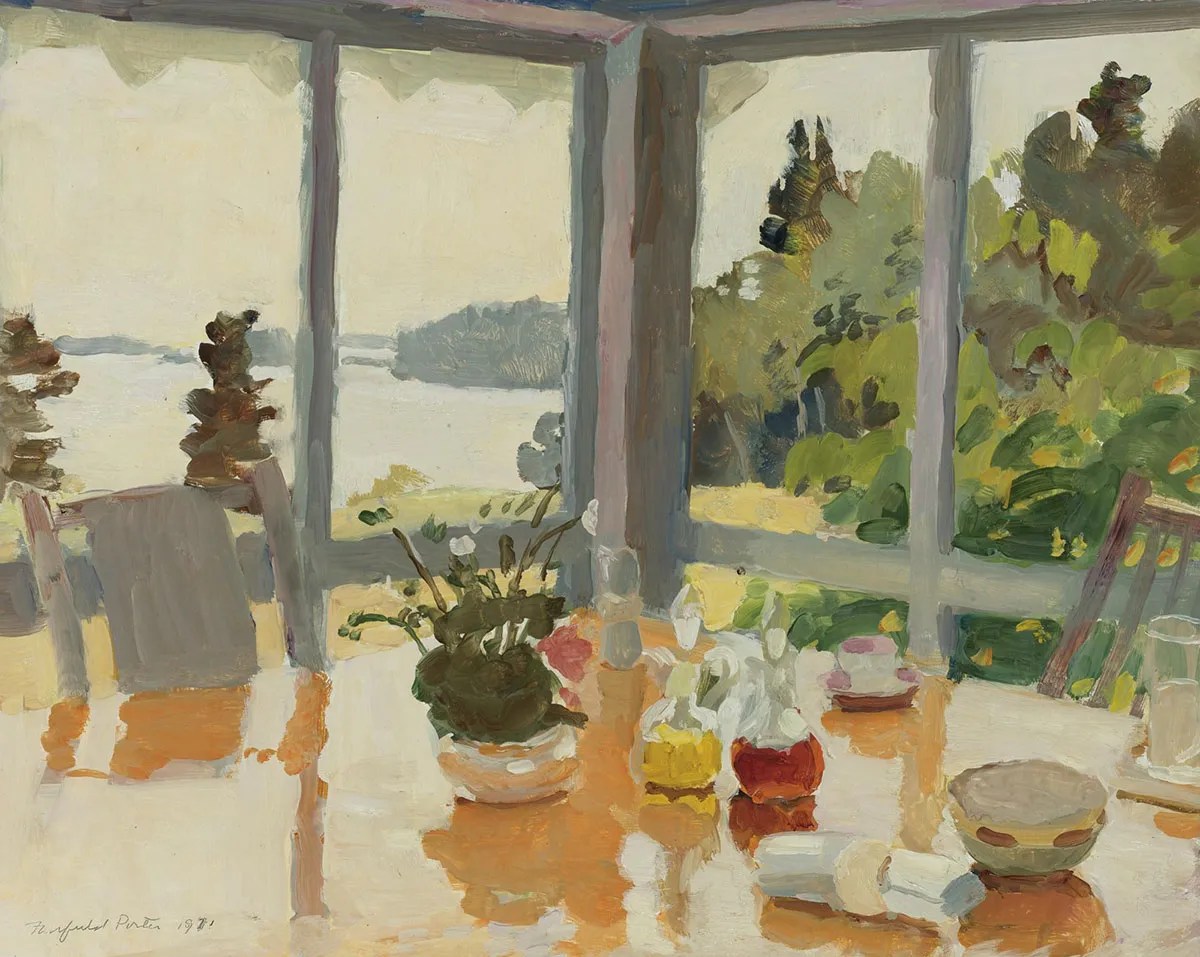
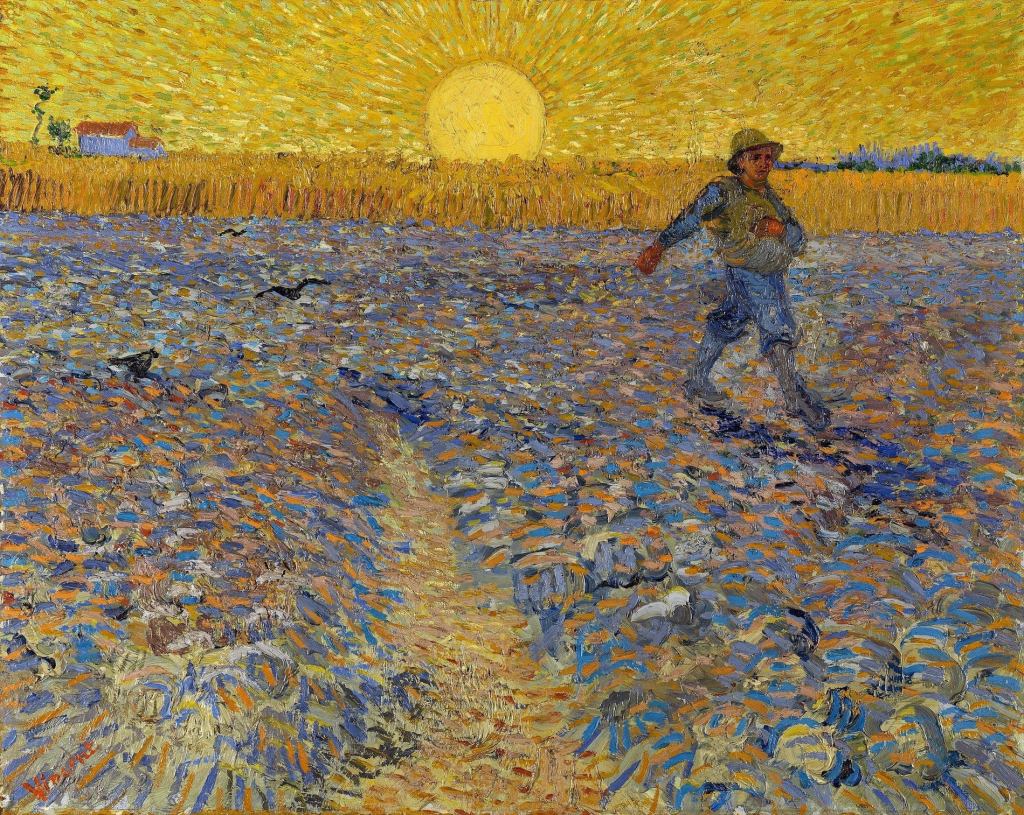
Like many of Dickinson’s poems she hides the key to understanding within the first sentence; within the very beginning. The crucial figure is ‘The Guest’. Who is this Guest? Dickinson often plays on imagery from nature, and with The Guest ‘gold and crimson’ sunset is embodied. It is a Guest ‘opal’ i.e opalescent, and the sky that has hitherto been grey now gets touched by gold and crimson, and our Guest’s Ermine doublet (the white clouds), and gay Capuchin (the sky is quite literally getting cloaked with the coming of darkness), is his grandiose and gentlemanly attire.
It is the phenomenon that reaches ‘town at nightfall‘, ‘stops at every door‘, yet finds no place to rest. Looking for the sunset (our Guest) in the morning, you will have to explore: ‘the Lawping’s shore!‘ which in the instance of this poem (geographically), and Dickinson’s physical location in Amherst, is on the Eastern Coast. Hence, the seeker must look East to find our splendid Guest again, as he rises in the East, breaking with nightfall.
Death
Our guest, however, is mirrored within Dickinson’s extraordinary habit of using double-imagery. Death, as it happens, is our Guest too. The metaphor of a ‘Guest’ is crucial as ‘the Guest’ versus a ‘resident’ is a temporary role. The Guest will arrive and do his bidding and then, leave again. A guest will not stay permanently. And just like the coming of death is a temporary feature, so is our life on earth. We are (in the words of Heidegger) thrown into the world, and will once again be thrown out. Resulting in us never feeling completely at home on earth.
Dickinson writes: ‘He reaches town at nightfall‘ which is the typical time of death. And like the unavoidability of sunset, so is Death a feature of permanence, hence he ‘stops at every door‘. Unyieldingly and repetitively as he has always done.
The next part is rather complex and interesting. Should someone have lost a loved one, Dickinson implores him/her to ‘pray‘; and here prayer has a double meaning. Either one must ‘explore‘ through prayer where their loved one is (‘who looks for him in the morning’ = ‘who’, is the one looking for death and their dead), meaning what one could see as the solitary, meditative act of communicating/reaching into the metaphysical substrate.
Or ‘explore’ could be a more religious/Biblical play on where our dead are residing (tying in well with the part above):
‘The Lark’s pure territory
Or the Lapwing’s shore‘
This is where we will once again find the dead; East where the sun will rise as it has always risen. Or East where The Garden of Eden (symbolically) is to be located. Hence one must direct his/her prayers toward ‘East’ where one can imagine them to be heard.
Sunset/Sunrise
With Sunset, naturally sunrise will follow. Will our dead rise again? Are our dead to be found on some axis we don’t have access to in our worldly sphere? Dickinson often plays on the worldly vs. the divine. Take ‘The Feet Of People Walking Home’ (P7 Thomas H. Johnson) in which she sets up her own ‘figures to tell‘ her ‘how far the Village lies‘. And how the ‘Classics veil their faces‘ contrary to the person’s own, ‘My faith‘. While we may have the ‘Classics’ to support us here on earth, there is a radical distinction between the worldly knowledge contained therein, and where (according to the poem) faith can take us.
(Dickinson’s own religious adventure is both peculiar and important, and it will have to be treated in later posts).
Death is our – what?
In the tradition of Shakespeare (Dickinson had read him avidly, she had gone so far as to hint that in essence no other book, no other author would be needed upon reading Shakespeare [and I could almost agree]. . .), the sun is personified as a masculine entity, and so is death. Death is dressed up in splendid clothes, akin to a magnificent pre-Victorian gentleman. This can be seen as in the tradition of Shakespeare’s tragicomedy. Death is a tragic occurrence, yet, he is dressed up in bright and vivid clothes that can only have the reader smile. Perhaps he is not something to be overtly feared, but rather A Guest, A Gentleman, who is here to take us to a place that is — possibly better?
We do see Dickinson play with the role of death in several poems as a man or entity of gentlemanly nature.
Take ‘Because I Could Not Stop for Death’ (P712 Thomas H. Johnson) in which Dickinson ‘could not stop for Death‘ so he ‘kindly stopped for me’. Here Death ‘Knew no haste‘ and feels almost like a trusted one. Someone we can rely on when it is our time to depart; despite the tragic circumstance. However, with the promise of sunrise after sunset, Death is possibly promising us something else too. Something other.

 Paradiso
Leave a comment